Does Tirana Have An Old Town?
Tirana has no walled old town like Berat or Kruja, but Ottoman-era fragments survive around Skanderbeg Square, Et'hem Bey Mosque, Tanners' Bridge and Tirana Castle. Here is what remains and where to find it.
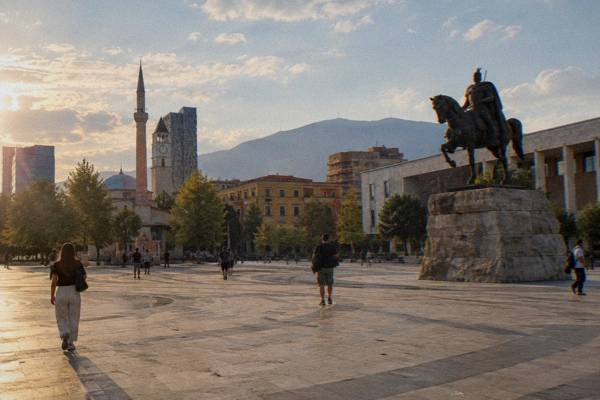
Tirana, the capital of Albania, does not have a walled old town in the way that Berat, Gjirokaster or Kruja do. What it has instead is a scattered set of Ottoman-era survivors clustered around Skanderbeg Square: the Et'hem Bey Mosque, the Clock Tower, Tanners' Bridge, the walls of Tirana Castle and the bazaar streets east of the square. The city was founded in 1614 by Sulejman Pasha Bargjini, who built a mosque, a bath, a bakery and an inn as its core, according to the municipality's own history page. But Tirana became a capital only in 1920, by decision of the Congress of Lushnja, as reported by ATA, and the decades of redevelopment that followed, including the communist rebuilding from 1944 to 1991, cleared away far more of the old fabric than they kept.
No, Tirana does not have a compact, preserved old town with narrow medieval lanes and a wall. It has a loose cluster of Ottoman-era monuments around Skanderbeg Square, roughly a ten-minute walk end to end, mixed with ministry buildings, apartment blocks and boulevards from later eras. The nearest thing to a historic quarter is the strip from Et'hem Bey Mosque east to Tanners' Bridge and Tirana Castle, with the New Bazaar alongside it.
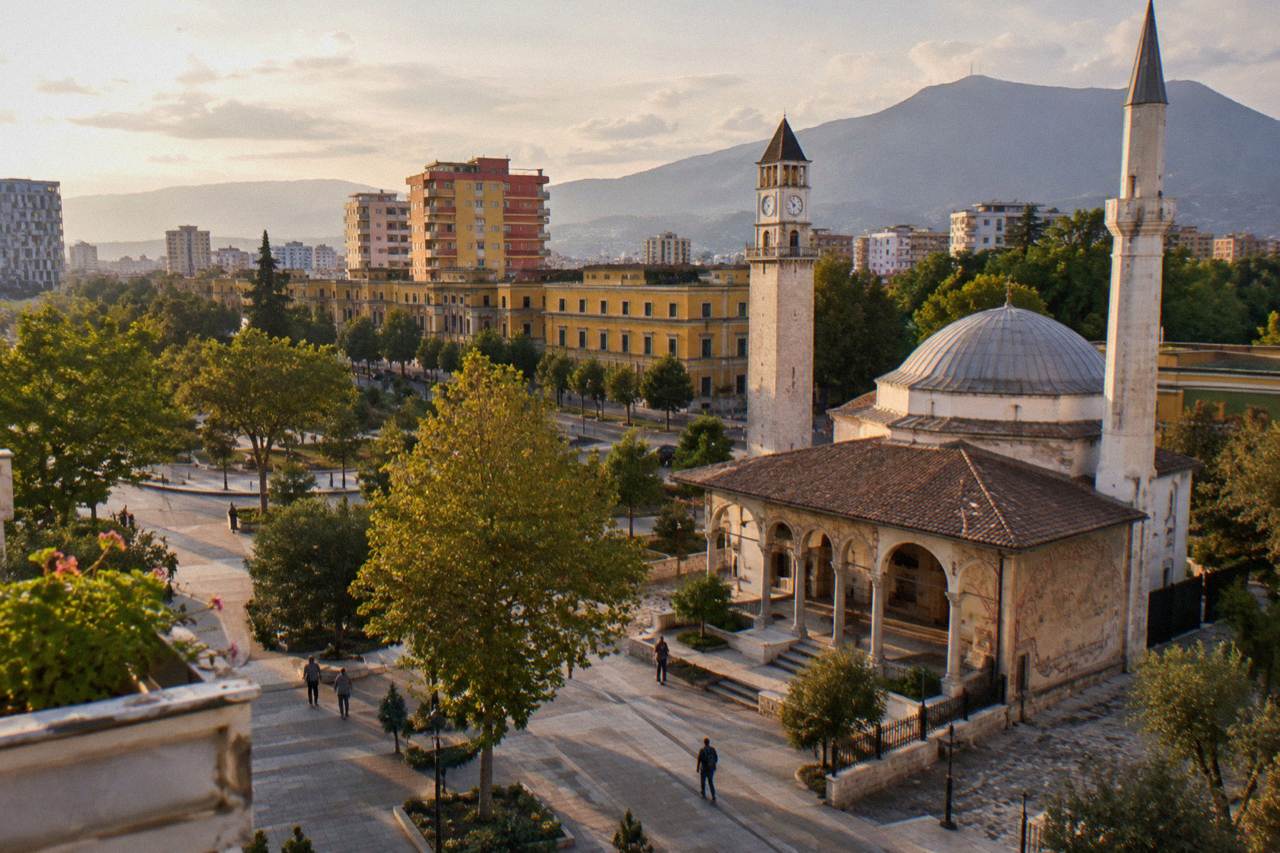
That strip is genuinely old in parts, and it is walkable in under an hour, which is why the question keeps coming up. The Et'hem Bey Mosque sits about 0.2 km south-east of the square, directly beside the Clock Tower, and its painted porch is the single most photographed piece of old Tirana. The mosque was founded at the end of the 18th century by Mulla Bey and finished by his son Haxhi Et'hem Bey, per the visit-tirana listing, and it is free to visit outside prayer times with modest dress. From there, the old route ran east towards Tanners' Bridge, about 0.7 km east, an Ottoman stone footbridge that once carried craftsmen over a creek; the creek is gone, and the bridge now stands at street level beside a road.
What confuses visitors is that none of this feels like Dubrovnik or like Berat's white Ottoman houses stacked up a hillside. Tirana's centre was reshaped again and again, most recently in the Skanderbeg Square redesign completed in 2017 by the studio 51N4E, per architectural reporting on the project, which turned the square into a gentle pedestrian pyramid of stone. The result is a city where the old town is a set of markers on a modern grid rather than a district you can wander into and stay inside. If your heart is set on an intact Ottoman old town, this page's day-trip table further down shows the towns within reach. For more on what the city is known for, see What Is Tirana Famous For.
What Survives From Ottoman Tirana?
Five things survive from the Ottoman centuries in or near the centre: the Et'hem Bey Mosque, the Clock Tower with roughly 90 steps, Tanners' Bridge, the walls of Tirana Castle, and the bazaar tradition that continues at Pazari i Ri, about 0.6 km east of the square. Everything else Ottoman was rebuilt, demolished or absorbed into later construction, according to the city's own historical accounts.
The mosque deserves the most time. It is one of the few buildings that survived the communist era intact; the listing records that it was spared in 1967 when religious buildings elsewhere were closed, and that on 18 January 1991 about 10,000 people entered it despite the authorities, an event now remembered as an early crack in the regime. The frescoes on the porch, unusual for Islamic architecture of the period, depict landscapes and still lifes alongside the geometric work. The Clock Tower next door, also about 0.2 km south-east of the square, was the city's timekeeper; local guides report about 90 steps to the top, and you should confirm opening arrangements on the spot, since posted hours have varied.
| Ottoman-era survivor | Position from Skanderbeg Square | What you see today |
|---|---|---|
| Et'hem Bey Mosque | About 0.2 km south-east | Painted porch, frescoes, working mosque, free outside prayer times |
| Clock Tower | About 0.2 km south-east | Stone tower, about 90 steps reported, views over the square |
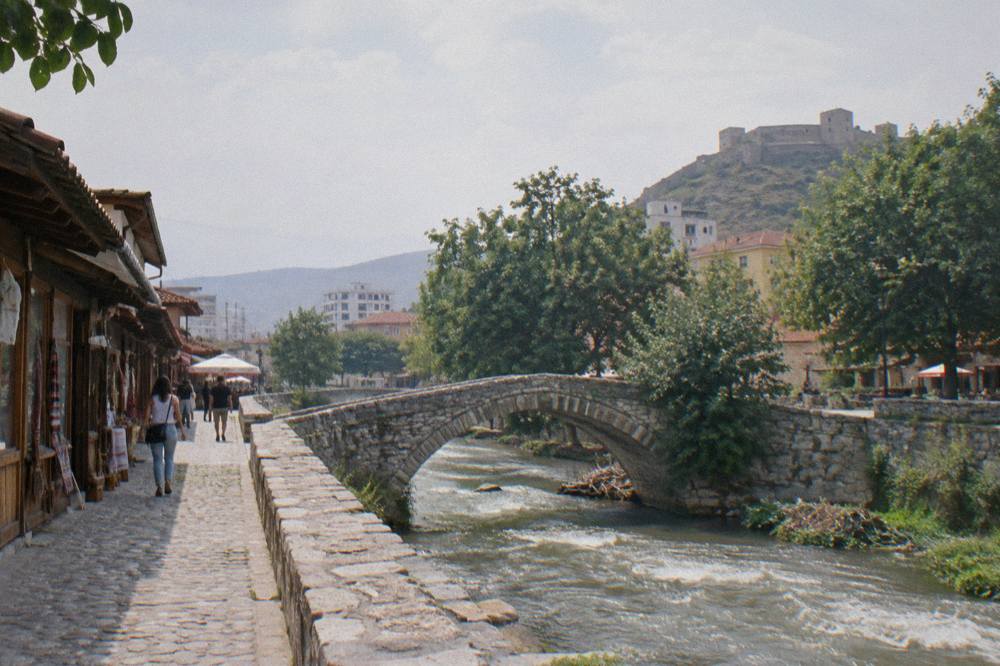
| Tanners' Bridge | About 0.7 km east | Ottoman single-arch footbridge, now at street level |
| Tirana Castle walls | About 0.5 km south-east | Fragment of walls and gates around the Kalaja dining quarter |
| New Bazaar (Pazari i Ri) | About 0.6 km east | Colourful market streets continuing the bazaar tradition |
Tirana Castle, the Kalaja, is the least castle-like of the five: today it is a walled dining and shopping lane built into the remains of an old fortress, and no construction date for the walls is on record, so treat their age as uncertain. The New Bazaar is a rebuilt market street, colourful and busy rather than ancient, but it keeps the commercial thread that Sulejman Pasha's inn started in 1614. Walking this whole set in a loop takes a relaxed morning, and it pairs naturally with a guided walk: the Tirana history and culture walks on this site cover both the Ottoman fragments and the modern layer around them. A small-group option with a focus on the communist layer, which explains why so little of the old town survives, can be checked here: Communist Past Small-Group Tour.
Where Is The Historic Core Of Tirana Today?
The historic core of Tirana today is the rectangle between Skanderbeg Square and the New Bazaar, about 600 metres across, containing the mosque, the Clock Tower, the government quarter around them, the House of Leaves museum about 0.2 km south-west, and the castle walls about 0.5 km south-east. It is a working city centre with a historic spine, not a protected old town.
Walking it is straightforward. Start on the square itself, where the mosaic facade of the National History Museum still faces the open space; the museum behind it has been closed for restoration since 15 March 2024 and the announced closure runs to about March 2028, so plan around it. Cross to the mosque and tower, then take the lanes south-east towards the castle walls, detouring to the House of Leaves, the Museum of Secret Surveillance, which the museum's own site lists as open daily from 09:00 to 19:00. The distance from the square to the House of Leaves is only about 200 metres, which tells you how compact this layer is.
One thing that surprises walkers is how much of the "old town feel" in Tirana actually comes from the boulevards and government buildings laid out after the city became the capital in 1920, not from the Ottomans. Blloku, about 0.8 km south, began as a closed officials' quarter and only opened up after 1991; its cafe-and-bar identity is recent. Old Tirana lives in five monuments and a memory, spread across a modern downtown. If you are working out how long to give the city, the guide to how many days in Tirana is enough breaks it down by pace.
How Does Tirana Compare With The Real Old Towns Nearby?
Berat, Kruja and Gjirokaster all have genuine preserved old towns within reach of Tirana, and each beats the capital for Ottoman atmosphere: Kruja is about 45 minutes by road, Berat about two hours, and Gjirokaster about three and a half. Berat and Gjirokaster are UNESCO World Heritage historic centres, inscribed in 2005 and extended in 2008, per UNESCO's listing. For an intact old town, they are the answer.
Kruja is the practical choice for a half-day: about 36.7 km from Skanderbeg Square, roughly a 45-minute drive, with a castle, a Skanderbeg museum and a restored bazaar street. Skanderbeg himself took Kruja on 28 November 1443 and the League of Lezha followed on 2 March 1444, per the standard timeline of his rebellion. The castle's official AKT page prints no fee or hours, so confirm at the gate.
| Old-town day trip from Skanderbeg Square | Road distance | Approximate drive time | Old-town character |
|---|---|---|---|
| Kruja | 36.7 km | About 45 min | Castle, bazaar street, Skanderbeg museum |
| Durres | 37.2 km | About 39 min | Roman amphitheatre and old walls beside the sea |
| Elbasan | 39.5 km | About 42 min | Walled Ottoman town centre |
| Shkoder | 98.4 km | About 118 min | Old streets, Rozafa Castle nearby |
| Berat | 124.6 km | About 122 min | UNESCO white Ottoman houses, castle quarter |
| Gjirokaster | 219.0 km | About 209 min | UNESCO stone old town, castle, best overnight |
Berat, about 124.6 km away, is the one to pick if you can give it a full day or a night: its castle quarter and the stacked windows of the Ottoman houses are exactly the image people expect when they ask about an old town. Gjirokaster, about 219 km, is too far for a comfortable day trip from Tirana and works better as an overnight stop on the way south. A guided Berat or Durres excursion handles the transport; one Durres option combines the Roman amphitheatre with the Adriatic beach, and it appears in the picks below.
The lesson from the comparison is simple: use Tirana as the base, see its five Ottoman survivors in a morning, and spend a day trip on a real old town rather than hunting for one inside the capital. If you are staying longer, How Many Days In Tirana Is Enough sequences the city sights against the day trips.
Can You Walk Tirana's Historic Sights In One Morning?
Yes, the surviving historic sights of Tirana fit into one morning walk of roughly 2 km: Skanderbeg Square, Et'hem Bey Mosque, the Clock Tower, the House of Leaves, the castle walls at Kalaja and the New Bazaar can be linked in a loop at a relaxed pace, with the furthest point, Tanners' Bridge, about 0.7 km east of the square. Comfortable shoes and modest dress for the mosque are the only requirements.
The route runs like this. Begin on Skanderbeg Square, the city's great open space and the reference point for every distance in the centre. Move to the mosque and tower on its south-eastern edge, then walk 200 metres south-west to the House of Leaves for the surveillance-museum layer of the city's past. Return east through the lanes to Tirana Castle's walls about 0.5 km south-east, stop at the New Bazaar about 0.6 km east, and finish at Tanners' Bridge about 0.7 km east if you want the full set. The terrain is flat, the pavements are ordinary city pavements, and there is no wall, gate or ticket for the district as a whole. The mosque is free outside prayer times; House of Leaves tickets are sold at the door. For everything else in the city beyond the historic layer, the main Tirana attractions page is the site's round-up.
Common Questions About Tirana's Old Town
These are the questions readers ask after the main one, answered short: Tirana's old town is small and scattered, it is free to wander, the mosque is the oldest-feeling stop, and the true old towns of Berat, Kruja and Gjirokaster are all reachable as day trips or overnights from the capital.
Does Tirana Have An Old Town?
No walled or preserved one. Tirana has a loose cluster of Ottoman-era monuments around Skanderbeg Square: Et'hem Bey Mosque, the Clock Tower, Tanners' Bridge, Tirana Castle's walls and the New Bazaar, all within about a kilometre of each other.
When was Tirana founded?
According to the municipality's history page, Tirana was founded in 1614 by Sulejman Pasha Bargjini, who built a mosque, a bath, a bakery and an inn as the settlement's core.
Can you visit Et'hem Bey Mosque?
Yes, free of charge and outside prayer times, with shoulders and knees covered and shoes removed at the entrance; scarves are provided for women as a courtesy.
Is Tirana Castle a real castle?
The Kalaja is a fragment of old fortress walls now wrapped around a dining and shopping lane. No construction date for the walls is known, so treat their age as uncertain and enjoy the atmosphere.
Which nearby town has the best old town?
Berat and Gjirokaster are UNESCO-listed historic centres; Kruja is the quickest reach at about 45 minutes by road from Skanderbeg Square. All three outdo Tirana for intact Ottoman streets.
Is the area around Skanderbeg Square safe to walk?
The central sights sit in a normal working city centre; watch your belongings in crowds as anywhere. Note that demonstrations have been held in central Tirana since 13 October 2026, and the FCDO advises avoiding them and checking local media.
The short version: come to Tirana for the mix of Ottoman fragments, communist history and modern cafe life, and take a day trip for the full old-town experience. More on the city's layers is on the Tirana Albania Travel Guide homepage, including the Kruja day-trip guide if the bazaar-and-castle morning appeals.