What Is Tirana Famous For?
Tirana, the capital of Albania, is famous for Skanderbeg Square, its communist-era bunkers and pyramid, the Bunk'Art museums, Blloku's cafe life and Mount Dajti. A full answer from the Tirana Albania Travel Guide.
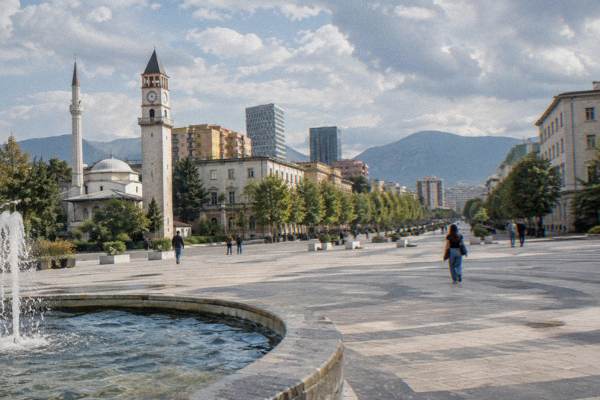
Tirana, the capital of Albania, is famous for one of the most unusual cityscapes in Europe: an Ottoman mosque and a clock tower standing beside a closed national museum, a climbed-all-over concrete Pyramid, two atomic-bunker museums, and a cable car that lifts you out of the whole thing onto Mount Dajti. The city sits inland in a basin at the foot of that mountain, with the Adriatic coast at Durres about 37 km and 39 minutes away by road, so it is a base for the coast rather than a beach city itself. Reported histories date the town to 1614, when Sulejman Pasha Bargjini built a mosque, a hamam, a bakery and an inn on the site, and it became the capital by decision of the Congress of Lushnja on 11 February 1920. What follows is the full answer, sight by sight, with the current 2026 conditions folded in.
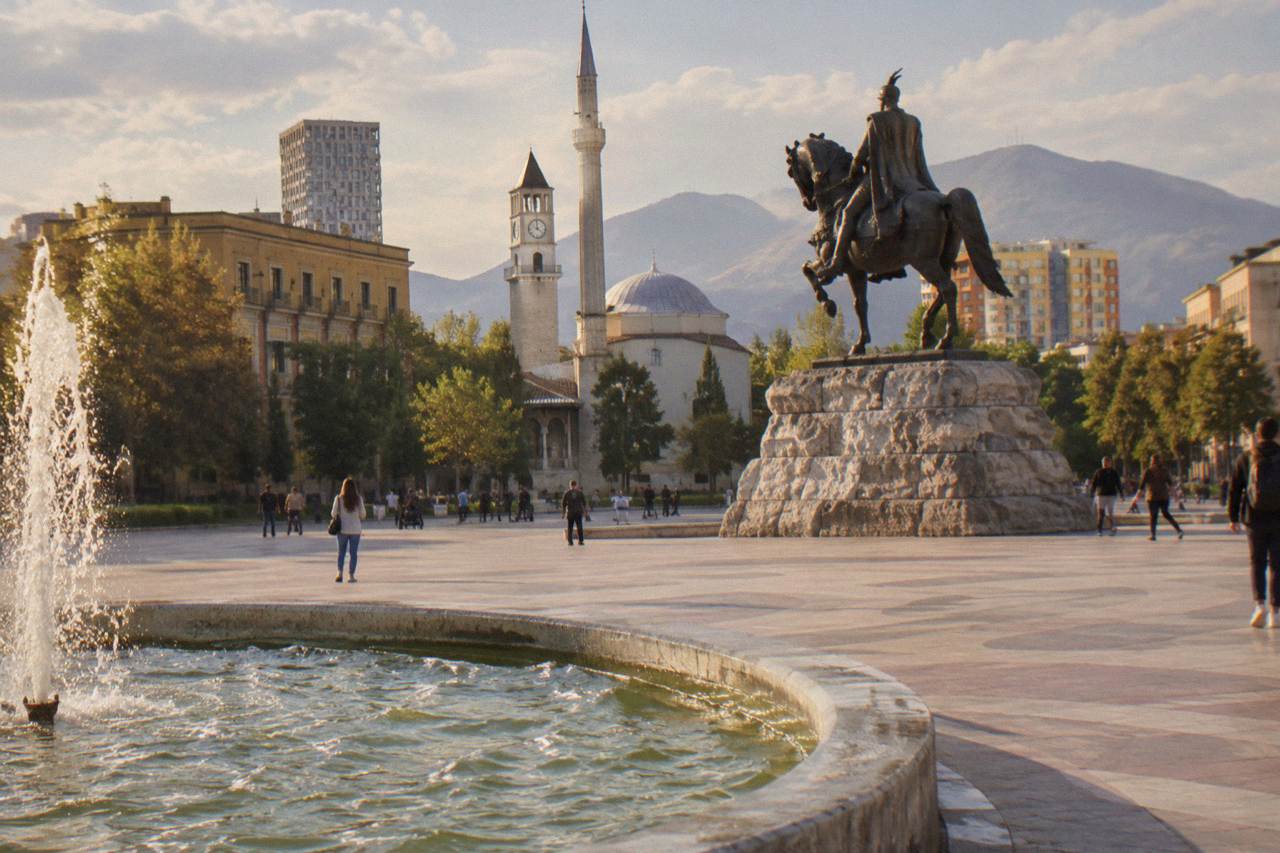
Tirana is famous for Skanderbeg Square at its centre, the Bunk'Art museums inside two communist-era bunkers, the renovated Pyramid of Tirana, the Blloku cafe and bar quarter, the Et'hem Bey Mosque, and the Dajti Ekspres cable car up Mount Dajti. It is also known as a cheap-feeling, fast-changing capital where Ottoman, Italian-era and communist architecture stand within a few hundred metres of each other.
That combination is the short version. The longer version is that almost everything people picture when they picture Tirana fits inside a walking loop of roughly two kilometres, from the square itself down through the Pyramid to Blloku, with Bunk'Art 2, the House of Leaves and the New Bazaar folded in along the way. The Albania tourism authority describes Skanderbeg Square as one of the city's most important and well-known public spaces, and the 2017 pedestrian redesign by the studio 51N4E turned it into a stepped, car-free pyramid of stone that people sit on all evening.
Two things catch out anyone planning around old guidebooks. The National History Museum on the square has been closed for restoration since 15 March 2024, with the announced closure running to about March 2028, though its mosaic facade is still visible from the square. And the currency is the Albanian lek, not the euro: Albania is outside the EU and Schengen, running its own 90-in-180-day visa regime, and the Bank of Albania's official rate on 23 October 2026 was about 90.74 lek to the euro.
| Landmark | Direction From Skanderbeg Square | Straight-Line Distance |
|---|---|---|
| Et'hem Bey Mosque | south-east | about 0.2 km |
| Clock Tower of Tirana | south-east | about 0.2 km |
| Bunk'Art 2 | south-east | about 0.2 km |
| House of Leaves | south-west | about 0.2 km |
| Pyramid of Tirana | south-east | about 0.7 km |
| Blloku | south | about 0.8 km |
| Grand Park of Tirana | south-east | about 2.1 km |
| Bunk'Art 1 | north-east | about 4.6 km |
| Dajti Ekspres lower station | north-east | about 4.4 km |
Skanderbeg Square And The Landmarks Around It
Skanderbeg Square is the focal point: a car-free, stone-paved space named after Albania's national hero, with the Et'hem Bey Mosque and Clock Tower at one edge, the closed National History Museum at another, and the Clock Tower's roughly 90 steps climbable nearby. The equestrian statue of Skanderbeg stands at its centre. Everything else famous in Tirana is within walking or short-bus reach of it.
The square is the place the city keeps returning to. Demonstrations have been held there and in central Tirana since 13 October 2026, some violent, and the UK FCDO updated its travel advice on 15 October 2026 to tell visitors to avoid demonstrations and check local media, so treat the square as a place to check current conditions before planning an evening around it. The Tirana Marathon, for its part, was moved from 24 to 25 October to 14 and 15 November 2026 because of the unrest.
Around the square, the Et'hem Bey Mosque is the oldest surviving religious building in the centre. The records describe it as founded at the end of the 18th century by Mulla Bey and finished by his son Haxhi Et'hem Bey, and it is free to visit outside prayer times with shoulders and knees covered and shoes off, as courtesy at any working mosque. The Clock Tower beside it has about 90 steps to the top. The Great Mosque of Tirana, the Namazgah Mosque, opened on 10 October 2024 about 0.6 km south-east of the square and is now one of the largest mosques in the Balkans. The Resurrection Cathedral stands about 0.2 km south.
For first-time planning, the things to do in Tirana overview collects the full sight list, and How Many Days In Tirana Is Enough works out the pacing.
Bunk'Art And The Bunker Story Tirana Is Famous For
Tirana is famous for its bunkers, above all the two Bunk'Art museums: Bunk'Art 1, a vast anti-atomic shelter behind the Dajti cable car's lower station, open daily 09:30 to 17:30 since 1 June 2026, and Bunk'Art 2, an interior ministry bunker about 0.2 km south-east of the square, open daily from 09:30. Neither museum publishes a ticket price online, so tickets are bought at the door.
Bunk'Art 1 opened to the public in November 2014 and Bunk'Art 2 on 19 November 2016, per the museums' own reporting, and together they are the clearest reason Tirana reads differently from any other Balkan capital. The bunker programme they document produced the small domes still visible in fields across the country; the commonly cited estimate is about 173,000 of them, though estimates differ and the figure should be treated as an approximation rather than a count. A third stop on the same theme is the House of Leaves, the Museum of Secret Surveillance, open Monday to Sunday 09:00 to 19:00, which the museum's own site lists, and the Postbllok memorial about 0.9 km south, which combines a bunker, Spac prison pillars and a fragment of the Berlin Wall.
A guided walk of the communist landmarks ties these places into one narrative, and it pairs naturally with the Which Is Better, Bunk Art 1 Or Bunk'Art 2 comparison if you only have time for one bunker.
The Pyramid, Mount Dajti And The Views Over The City
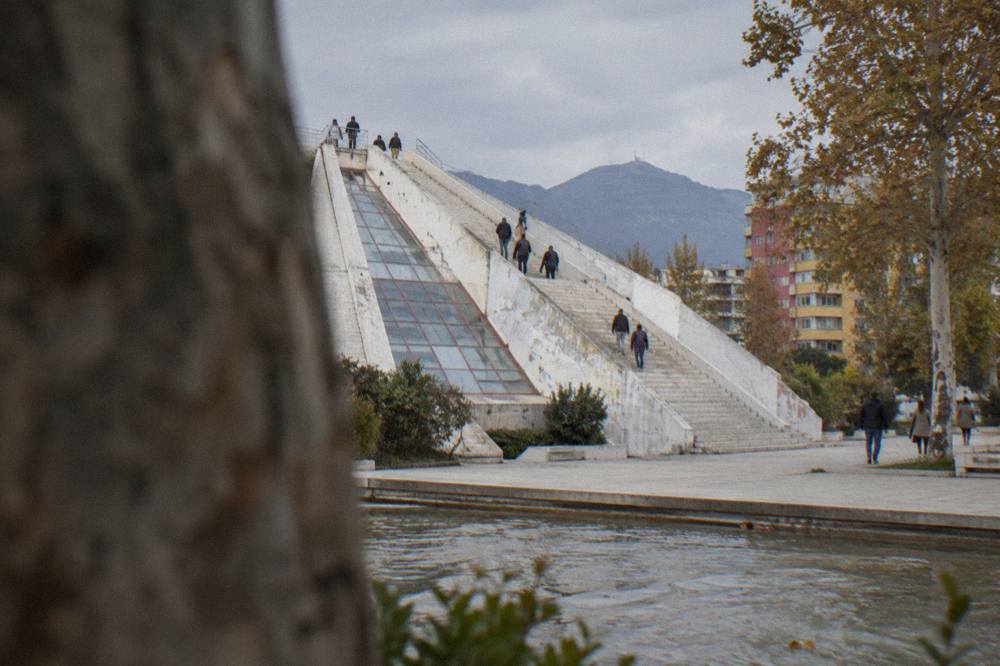
The Pyramid of Tirana, opened in 1988, abandoned, and renovated and reopened in May 2023 as the TUMO technology centre, is famous for its stepped exterior that people climb for free to a viewing platform. The Dajti Ekspres cable car, described by its operator as the longest cableway in the Balkans, runs from the north-eastern edge of the city up Mount Dajti, whose summit lies 9.8 km from the square as the crow flies.
The Pyramid is the single most photographed shape in Tirana, and unlike during its derelict decades it is now a functioning building again, never a ruin. The steps are open and free to climb, per local guides, though the interior TUMO areas keep their own hours. Mount Dajti is the other half of the skyline: the cable car is usually closed on Tuesdays for maintenance, per the operator's schedule, tickets are sold only at the lower station, and the operator publishes no fares online, so check the current price at the lower station before going. The road route up the mountain takes about 53 minutes over 28 km.
Beyond the mountain, the city's green anchor is the Grand Park of Tirana with its Artificial Lake, about 2.1 km south-east of the square, and the Sky Tower's rotating restaurant about 0.7 km south offers a panorama of the whole basin.
Blloku, Coffee And The Food Tirana Is Known For
Blloku, about 0.8 km south of the square, is the cafe, bar and restaurant quarter Tirana is famous for, a grid of low villas that was once the closed residential zone of the communist leadership and is now where the city's cafe culture and nightlife concentrate. The food the city is known for is byrek, qofte, tave kosi and fergese, washed down with raki or thick coffee.
The transformation of Blloku from a restricted enclave into the city's living room is the story every guide tells, and it is visible in the architecture: perimeter walls, villa plots, and now a dense run of cafes. Bars here fill from the evening onward and run late into the night, and the question Is Tirana Nightlife Good gets its own full answer elsewhere on this site. The New Bazaar, Pazari i Ri, about 0.6 km east of the square, is the produce-and-grill market quarter, and Tanners' Bridge, about 0.7 km east, is an old Ottoman stone bridge surviving on a pavement.
On the plate, byrek is a layered filo pie, qofte are seasoned grilled meatballs, tave kosi is lamb baked under a yogurt and egg topping, and fergese bakes peppers and tomatoes with cheese. Whether the city is affordable is answered at Is Tirana Cheap Or Expensive.
Day Trips That Start In Tirana
Tirana is famous as a base: the coast at Durres is about 39 minutes away by road, Kruja with its castle and bazaar about 45 minutes, Petrela Castle about 22 minutes, and Berat, Shkoder and Ohrid are all reachable as long day trips of roughly two to two and a quarter hours each way, with Ohrid requiring the North Macedonia border crossing.
That spread is the practical reason the capital works as a hub. Durres pairs a Roman amphitheatre and archaeological museum with a sandy Adriatic beach; its museum entry runs a few hundred lek, per local reporting, so confirm current prices on arrival. Kruja is the Skanderbeg town, with the castle and old bazaar above it, reachable by minibus in about an hour for about 200 lek, per local guides. Lake Bovilla, a turquoise reservoir in the hills, is about 61 minutes out, and the Pellumbas cave walk about 47.
| Destination | Road Distance From Skanderbeg Square | Drive Time |
|---|---|---|
| Petrela Castle | 14.2 km | about 22 min |
| Durres | 37.2 km | about 39 min |
| Kruja Castle | 39.3 km | about 49 min |
| Shkoder | 98.4 km | about 118 min |
| Berat | 124.6 km | about 122 min |
| Ohrid (plus border) | 129.8 km | about 135 min |
Further afield, Gjirokaster, Saranda and Butrint are overnight or long-tour days, not half-day outings. Ohrid itself is a town in North Macedonia; the Albanian shore of the lake is Pogradec and Lin, and the UNESCO Ohrid listing was extended to the Albanian side in 2019. Tirana itself, for the record, has no World Heritage listing of its own.
For pace-setting, Can I Take A Day Trip From Tirana To Theth deals with the hardest timetable of all.
Common Questions About What Tirana Is Famous For
The questions below cover the specifics people search for after the headline answer: whether Tirana has an old town, what the Pyramid is, and what the weather does, answered from the same records as the rest of this page.
What Is Tirana Famous For?
Skanderbeg Square, the two Bunk'Art bunker museums, the climbed Pyramid, Blloku's cafe life, the Dajti Ekspres cable car, and its role as a base for Kruja, Durres, Berat and Ohrid. It is an inland capital in a basin, about 39 minutes by road from the sea at Durres.
Does Tirana Have An Old Town?
Not in the walled, medieval sense many expect, which is why the question has its own page at Does Tirana Have An Old Town. The closest things are the Ethem Bey Mosque and Clock Tower on the square, Tanners' Bridge, the Tirana Castle quarter about 0.5 km south-east, and the Ottoman street pattern east of the centre.
Can You Climb The Pyramid Of Tirana?
Yes. The stepped exterior is free and open to climb to a viewing platform, and the building now houses the TUMO technology centre after its renovation and reopening in May 2023. The full answer is at Can You Climb The Pyramid Of Tirana.
How Big Is Tirana?
The 2023 census counted about 598,000 residents in Tirana municipality, per Wikipedia citing INSTAT, and Albania counted 2,335,930 residents on 1 January 2026. Tirana county is the only county that grew in 2025, holding about 32.8% of the country's population, per INSTAT.
Is Tirana Worth Visiting For Tourists?
The square, the bunkers and the food scene make it a genuine two- or three-day city, and the question is Tirana worth visiting for tourists weighs both sides, including the October 2026 demonstrations and the closed National History Museum.
In short, Tirana is famous for being a capital you can read like a layered book: Ottoman at the mosque, Italian between the wars, hard communist in the bunkers and the Pyramid, and loudly present-tense in Blloku's cafes, all under a mountain you can ride up in a cable car. The Tirana Albania Travel Guide covers each of those layers in its own depth.