Do US Citizens Need A Visa For Albania?
No, US citizens do not need a visa for Albania or its capital Tirana: US passport holders can stay up to a year visa-free, and this page explains the rules, the passport checks and what to expect on arrival.
No, US citizens do not need a visa to enter Albania, the country whose capital is Tirana, an inland city in a basin at the foot of Mount Dajti with the Adriatic coast at Durres about 37 km and 39 minutes away by road. US passport holders can stay up to a year without a visa, per the Albanian foreign ministry's published regime as reported by secondary references, a far longer allowance than the 90 days in any 180-day period that applies to UK and EU nationals. Albania is not in the European Union and not in Schengen, so it runs its own border rules and its own counting, entirely separate from any Schengen clock a traveller may already be running in Greece, Croatia or Italy.
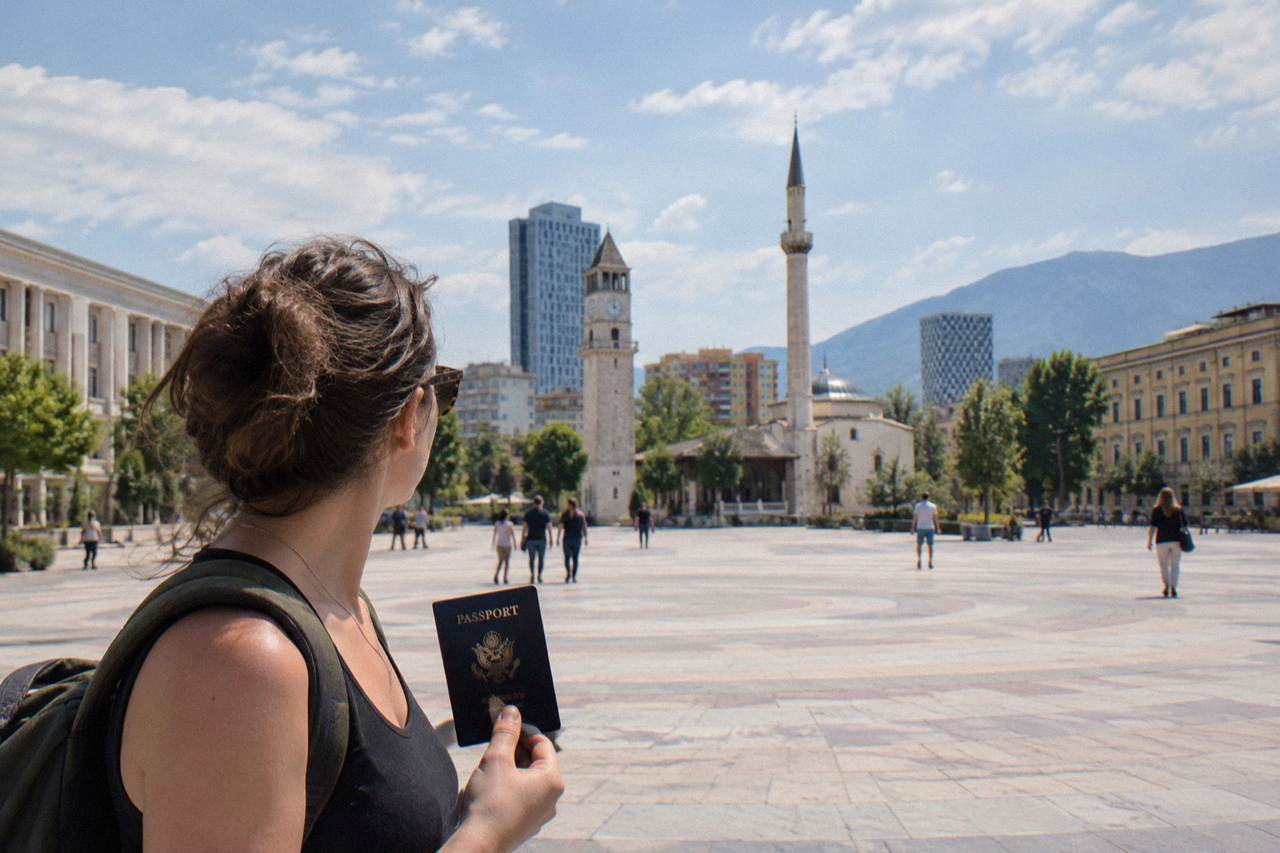
That headline answer comes with a short list of practical details: what document you actually hand over at Rinas, how long your passport needs to be valid, how the one-year allowance is counted, and what the border officer can still ask you for. The full entry rules, including the rules for other nationalities, are set out on the Albania entry requirements guide, and the money question that follows, whether you change dollars to euro or to lek, is answered on the US dollars in Albania page.
No, US citizens do not need a visa for Albania for stays of up to one year. US passport holders can stay up to a year without a visa, per the Albanian foreign ministry's published visa regime, so a tourist trip to Tirana needs no application, no fee and no pre-clearance of any kind. Confirm the current rule with the Albanian foreign ministry before you fly, since visa regimes can change.
Albania keeps a national visa list rather than following the EU's, because it is outside both the Union and Schengen. The United States sits on the visa-free side of that list with an unusually generous allowance: where UK and most EU citizens get 90 days in any 180-day period, the reported allowance for US passport holders runs to a full year from entry. For a city break, a fortnight or even a slow month in Tirana, the difference never comes into play. It matters only to long-stay travellers, students and remote workers, and anyone planning to stay beyond the allowance needs a Type D visa or a residence permit rather than a simple entry stamp.
One point worth separating out: a Schengen visa is not needed to enter Albania, and holding one is not what gets an American in. Your US passport does that on its own. The Schengen connection runs the other way and only helps other nationalities: travellers who do need a visa for Albania may enter visa-free if they hold a valid, previously used multiple-entry visa or residence permit from an EU member state, the USA or the UK. Americans skip that machinery entirely.
What Documents Does A US Traveler Show At Tirana Airport?
A valid US passport is the only document a US citizen needs to show at Tirana International Airport Nene Tereza at Rinas, about 15.9 km and 29 minutes by road from Skanderbeg Square. No visa, no onward-ticket printout and no pre-registration form exist for this route. The standard passport rule reported for Albania asks for at least three months of validity beyond your planned departure, so check your expiry date before booking.
In practice the border check at Rinas is short. The officer scans the passport, stamps it and asks the usual questions about the purpose and length of the stay. Formality beyond that is minimal: Albania has no arrival form for visa-free nationals and no equivalent of the EU's planned EES biometric registration, because it stands outside Schengen and runs its own regime. The stamp in your passport is what starts and proves your permitted stay, so keep the passport rather than a photo of it when moving around.
Two cautions. First, border officers anywhere can ask for evidence of onward or return travel, accommodation and sufficient funds; carrying a return confirmation costs nothing. Second, the one-year allowance comes from the Albanian foreign ministry's published regime, and entry rules change, so confirm the current wording with the ministry or your airline before departure if your stay will be a long one.
From the arrivals hall the standard route into the city is the airport bus: 24 hours a day, every full hour, 30 to 40 minutes, 400 lek or 4.50 euro, stopping behind the Palace of Opera and Ballet beside Skanderbeg Square. The official airport taxi runs about 2,200 lek. There is no airport train and no running Tirana-Durres passenger service while the line is rebuilt, with electrification expected by the end of 2027.
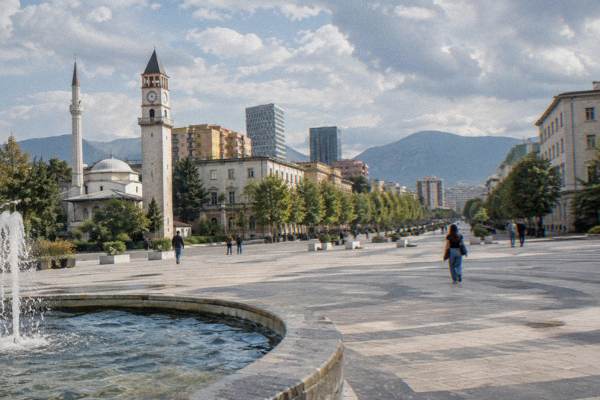
After the bus drops you at the square, the whole centre opens on foot. Skanderbeg Square itself, the Et'hem Bey Mosque about 0.2 km south-east of it, the Clock Tower alongside and the New Bazaar about 0.6 km east form a loop you can walk in an afternoon, and a guided walk stitches them together with the history in between, which is why the city walking tour is the natural first booking after a long flight. For planning the rest, the Is Tirana Worth Visiting For Tourists and the How Many Days In Tirana Is Enough cover the pacing question.
How Long Can US Citizens Stay In Albania Without A Visa?
US citizens can stay up to one year in Albania without a visa, a much longer window than the 90 days in any 180-day period given to UK and EU nationals. The allowance is Albania's own and is counted separately from any Schengen stay, so days in Albania neither use nor restore Schengen days.
The comparison matters for travellers combining countries. A month in Tirana followed by a month in Greece uses no Schengen allowance during the Albanian leg, because Albania is outside the system; the Greek days count separately on the Schengen clock. The same logic applies in reverse to the 90-in-180 rule for UK and EU citizens inside Albania itself, though for Americans the one-year allowance makes overstay a distant concern on any normal holiday.
Anyone whose plans push past the allowance, a year of remote work, a semester of study, a family stay, moves into different territory: a Type D long-stay visa or a residence permit applied for through Albanian channels. Those processes carry their own requirements and timelines, none of which are covered here, and the Albanian foreign ministry's visa-regime page is the reference to confirm first.
Here is how the main nationalities compare under Albania's own rules:
| Nationality | Visa needed? | Allowed stay | Notes |
|---|---|---|---|
| United States | No | Up to 1 year | Reported allowance per the Albanian foreign ministry; confirm before a long stay |
| United Kingdom | No | 90 days in any 180 | Passport valid at least 3 months beyond departure |
| EU member states | No | 90 days in any 180 | National ID card reported accepted |
| Visa nationals with a used multi-entry EU/UK/US visa or permit | No | Per the permit regime | Albania recognises these documents for visa-free entry |
Do ETIAS Or Any EU Entry System Apply At The Albanian Border?
No, neither ETIAS nor the EES biometric system applies at Albania's border, because Albania is not in the European Union and not in Schengen; it is an EU candidate country in accession negotiations running its own entry regime. US citizens entering at Rinas receive an Albanian stamp under Albanian rules, and no EU authorisation of any kind is requested or checked.
This trips up travellers who have read about Europe's new digital entry systems and assume they cover every country on the continent. They do not. ETIAS and EES are Schengen instruments, and Albania's border posts run their own procedures. An American whose trip is Albania only needs no ETIAS authorisation, pays no EES-style fee and gives no fingerprints on entry. If the itinerary later adds Greece, Italy or any Schengen state, then whatever rules those systems impose at that time apply at that border, separately.
The same independence shows up in money. Albania's currency is the lek, not the euro, and the Bank of Albania's official rate on 23 October 2026 was 90.74 lek to the euro, so "roughly 90 lek to the euro" is the working figure. Some hotels and tourist businesses accept euro informally at their own rate, but change normally happens in lek, and cards are widely taken in central hotels, larger restaurants and supermarkets while buses, markets and small cafes run on cash. The full currency picture, including what to do with dollars, is on the Does Albania Use The Euro.
What Should US Visitors Know About Tirana On Arrival?
US visitors arriving visa-free in Tirana land in a capital of about 598,176 residents at the 2023 census, an inland city at the foot of Mount Dajti where the currency is the lek, the emergency numbers are Police 112, Ambulance 127 and Fire 128, and the tap-water advice from UK authorities is to drink bottled water. English is spoken at a moderate level of proficiency nationally and somewhat better in Tirana itself.
A few current-conditions notes shape a 2026 arrival. Demonstrations have been held in central Tirana since 13 October 2026, some of them violent, and UK travel advice was updated on 15 October 2026 to tell visitors to avoid political gatherings and monitor local media; sights have stayed open through the period, and the practical effect for a visitor is route awareness around Skanderbeg Square on demonstration days. The National History Museum on the square is closed for restoration until about March 2028, though its mosaic facade can still be seen from the square itself.
The city itself rewards walking. The Pyramid of Tirana, about 0.7 km south-east of the square, is a renovated building housing the TUMO tech centre, its outside steps open and free to climb. Bunk'Art 2 sits about 0.2 km south-east of the square, open daily from 09:30, while Bunk'Art 1 lies about 4.6 km north-east behind the Dajti cable car lower station, open daily 09:30 to 17:30 since 1 June 2026; neither museum publishes a ticket price, so buy at the door. Blloku, the former leadership quarter turned cafe and bar district, is about 0.8 km south.
What Else Should Americans Plan Before The Flight?
Americans should plan three things before flying to Tirana: passport validity of at least three months beyond departure, lek or a card that works abroad for spending, and travel insurance that covers Albania, since US Medicare and many US plans do not pay for care abroad. Everything else, the visa question included, answers itself at the border with a passport stamp.
Practical prep is light. Power sockets are type C and F at 230 V, so US devices need an adapter and a voltage check. The time zone is Europe/Tirane, one hour ahead of London in winter, the same as most of continental Europe. Tipping percentages have no settled figure worth printing; service is rarely added to the bill, so round up or add at your own judgement. Ride apps Uber and Bolt do not operate; local taxi apps do, and the Is There An Uber In Tirana covers the alternatives.
For filling the days, the money page for the city is things to do in Tirana, and the D2 compact companion on Tirana Albania Travel Guide rounds up the walks, the mountain and the day trips. Americans staying a year could in theory work through all of it; a long weekend cannot, and choosing between the Bunk'Art museums is the usual first puzzle.
Common Questions About US Citizens And Albanian Visas
Do US citizens need a visa for Albania?
No. US passport holders can stay up to a year without a visa, per the Albanian foreign ministry's published regime. Confirm the current rule with the ministry before travel.
How long can a US passport holder stay in Tirana?
Up to one year visa-free, far longer than the 90 days in any 180-day period given to UK and EU nationals. Stays beyond that need a Type D visa or a residence permit.
Is Albania in the Schengen area?
No. Albania is in neither the EU nor Schengen; it is an EU candidate country in accession negotiations and runs its own visa regime, counted separately from any Schengen stay.
Do I need ETIAS to visit Albania?
No. ETIAS and the EES are Schengen systems and do not apply at Albania's border. They apply only if your itinerary continues into a Schengen state.
What currency should US visitors use in Tirana?
The Albanian lek, roughly 90 to the euro per the Bank of Albania rate of 23 October 2026. The euro is not legal tender; some businesses take it informally at their own rate, and cards work in hotels, larger restaurants and supermarkets.