The Pyramid Of Tirana: From Hoxha Museum To Climbable Tech Hub
The Pyramid of Tirana opened in October 1988 as a museum to communist-era leader Enver Hoxha, then reopened in May 2023 as a climbable tech hub. Here is what it is, how to visit it and what sits around it.
Short answer
The Pyramid of Tirana is a renovated 1988 monument about 0.7 km south-east of Skanderbeg Square, reopened in May 2023 as TUMO Tirana, a technology centre. The exterior steps are reported to be open and free to climb, and the site is a ten-minute walk from the square.
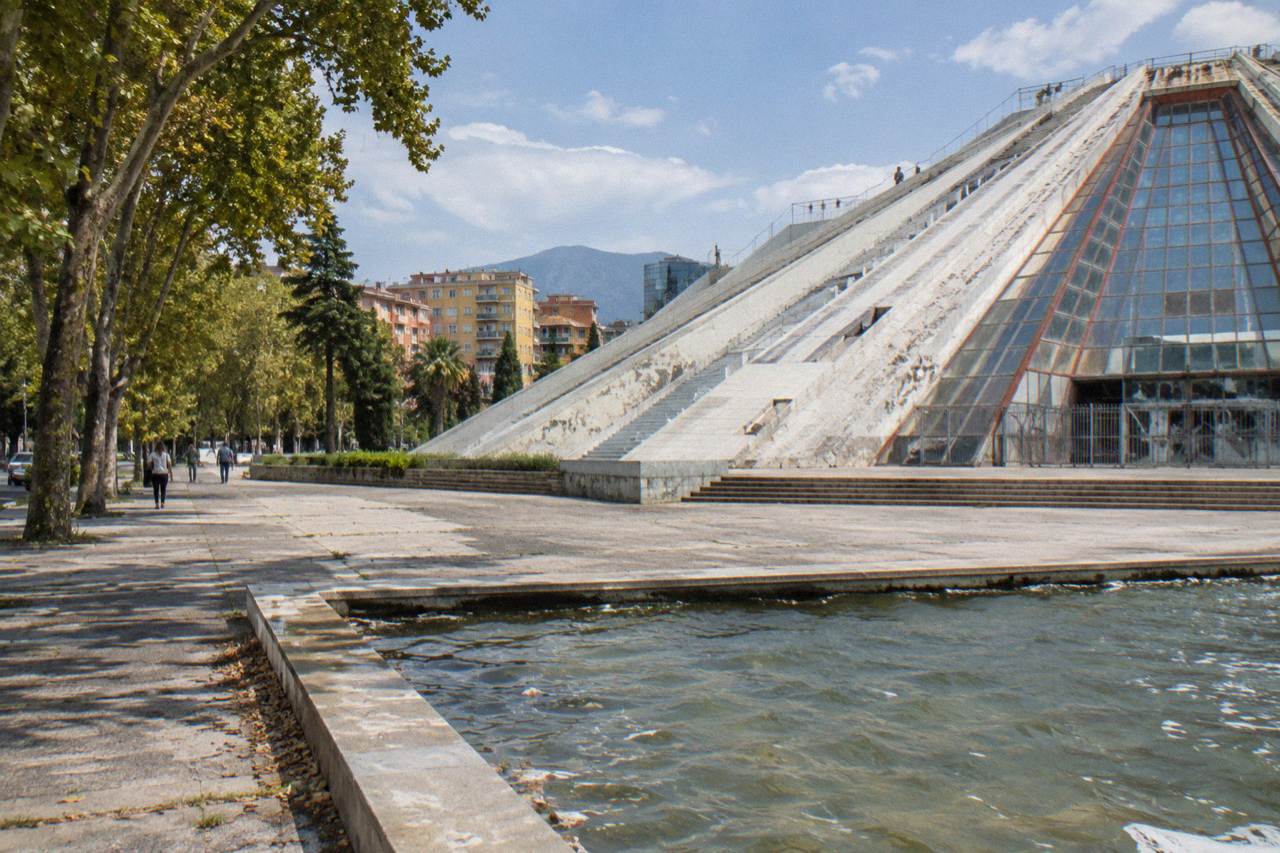
The Pyramid of Tirana is a steep, glass-and-concrete monument in the centre of Tirana, the capital of Albania, about 0.7 km south-east of Skanderbeg Square. It opened on 14 October 1988 as a museum dedicated to Enver Hoxha, the country's long-time communist leader. After years of abandonment and debate over demolition, it was renovated and reopened in May 2023 as the home of TUMO Tirana, an educational technology centre, with exterior steps reported to be open and free to climb. For the wider picture of the city, start with the Tirana Albania Travel Guide homepage and the things to do in Tirana overview.
What Is The Pyramid Of Tirana?
The Pyramid of Tirana is a large stepped building in central Tirana, about 0.7 km south-east of Skanderbeg Square, opened on 14 October 1988 and renovated by the Dutch studio MVRDV, reopening in May 2023. It now houses TUMO Tirana, a technology learning centre for young people, and its sloping exterior steps are reported to be free and open to climb.
It is not a ruin and it is not derelict, though plenty of older guidebooks still describe it that way. The renovation kept the building's structural shell, cut new openings into it and turned the stepped flanks into a public route up and over the structure, so that the building itself became a piece of street furniture. The interior is a working educational space rather than a conventional museum, and the exterior is the part a visitor actually experiences: steps, slopes, views over the boulevard and the square.
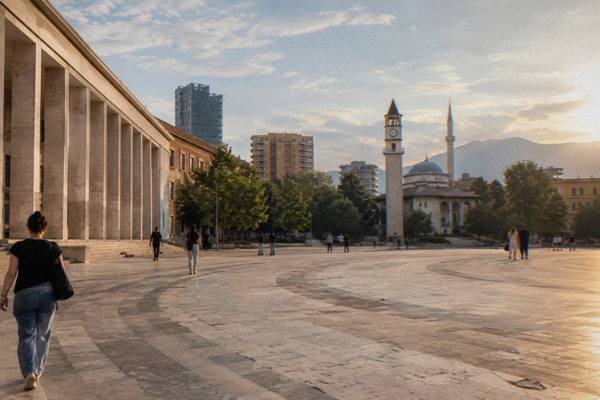
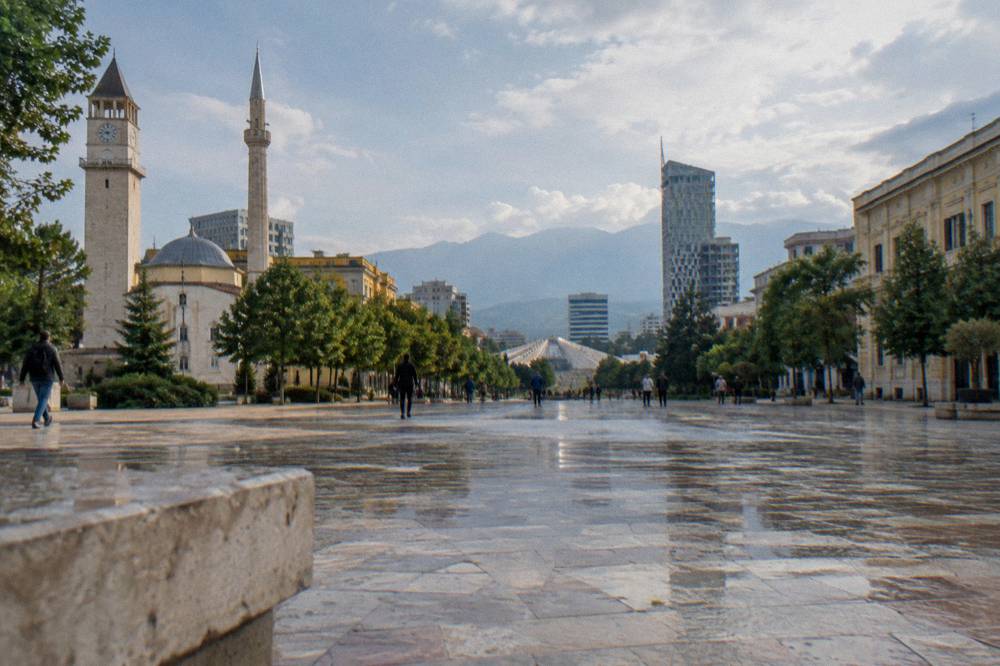
The building sits between the Lana-side parkland and the boulevard that runs south from Skanderbeg Square toward Mother Teresa Square, about 1.2 km further south. That position makes it an almost unavoidable landmark on any walk through the centre. It is close enough to the Clock Tower of Tirana and the Et'hem Bey Mosque that the three fit into one short stroll, and the answers page on climbing the Pyramid covers the practical question in detail.
| Pyramid of Tirana, key facts | Detail |
|---|---|
| Opened | 14 October 1988 |
| Reopened after renovation | May 2023 |
| Renovation architect | MVRDV (reported) |
| Current use | TUMO Tirana technology centre |
| Position | About 0.7 km south-east of Skanderbeg Square |
| Exterior steps | Free to climb (reported) |
| Interior | Educational centre; check access locally |
| Admission to the exterior | None |
Why Was The Pyramid Of Tirana Built?
The Pyramid was built as a museum dedicated to Enver Hoxha, the communist leader whose rule ran from 1944 to 1991 in Albania, and it opened on 14 October 1988, three years after his death. After communism fell, the building cycled through other uses until its 2023 renovation as a technology education centre.
The building's original name and function tied it directly to the cult of the leader it commemorated. Construction of a museum for Hoxha's legacy began while the regime still held power, and the opening in October 1988 came at the very end of that era. Within a few years the regime was gone, and the museum went with it. Later the building served various civic and cultural purposes, sat partly empty, and became the subject of repeated arguments about whether to demolish it, a debate that ran for years in Tirana.
The renovation that settled the question was completed in 2023, when the structure reopened as a home for TUMO, a network of after-school technology centres where teenagers work on design, animation, coding and robotics. The design approach, attributed to MVRDV in reporting on the project, was to open the building up rather than seal it: new stairways run over the exterior, and small pavilions were added around the base. The result is a monument people now walk over rather than file through.
For context on the period the building was born from, the House of Leaves, open daily 09:00 to 19:00, documents the secret-surveillance apparatus of the communist state, and a reported adult ticket costs 700 lek. The National History Museum on Skanderbeg Square would be the natural companion, but it has been closed for restoration since 15 March 2024, with the announced closure running to about March 2028; the mosaic facade is still visible from the square.
| Period | Role of the building |
|---|---|
| October 1988 | Opens as a museum to Enver Hoxha |
| After 1991 | Museum closes; building passes through civic and cultural uses |
| Before renovation | Derelict in part; demolition repeatedly debated |
| May 2023 | Renovation by MVRDV reopens it as TUMO Tirana |
| Since 2023 | Free public exterior steps, working tech centre inside |
Can You Climb The Pyramid Of Tirana?
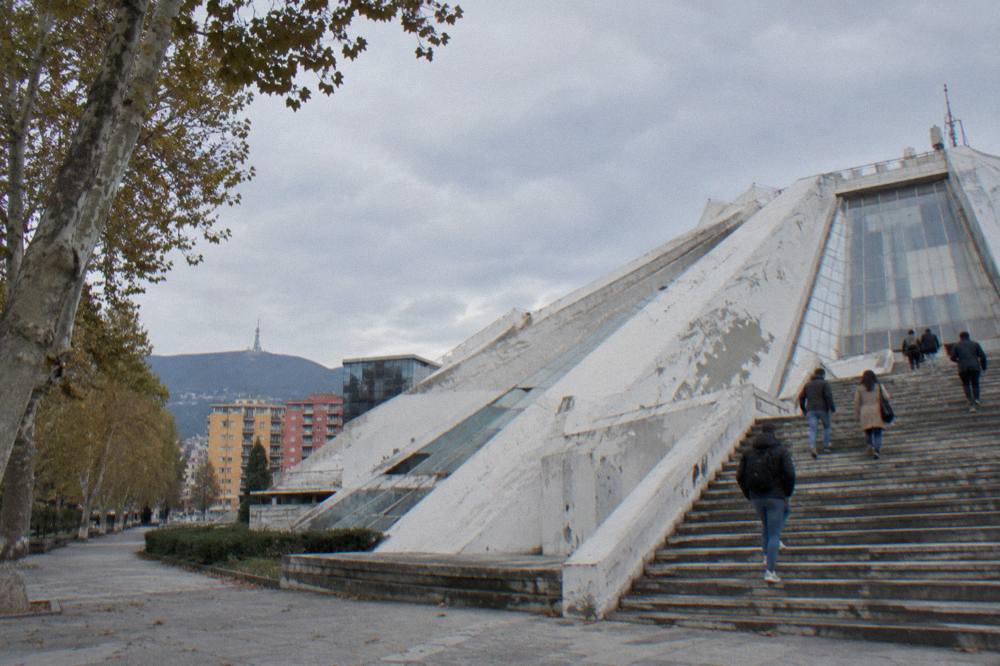
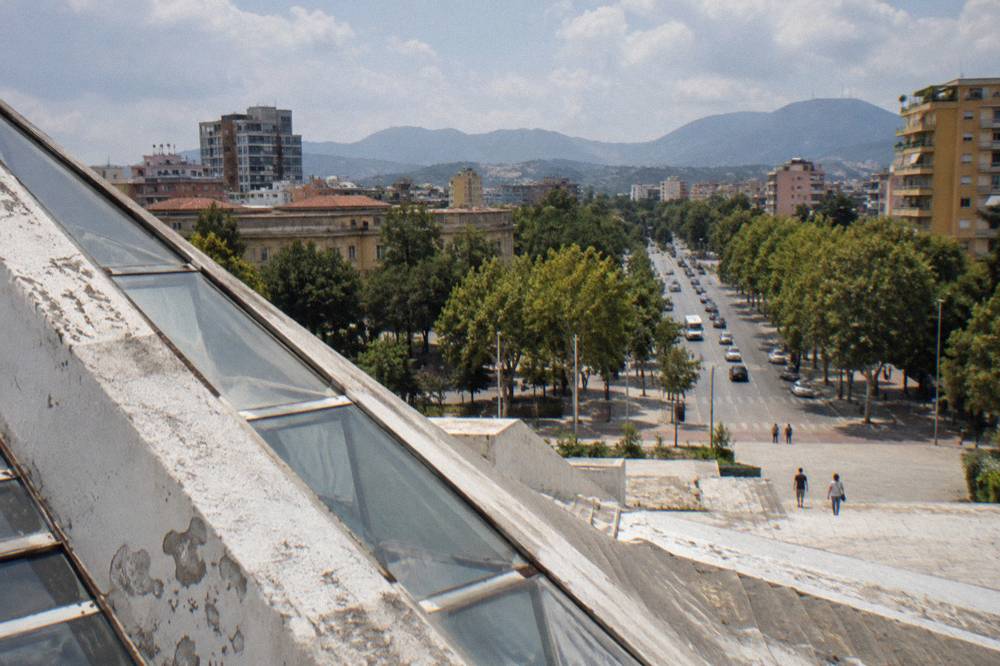
Yes. The exterior steps of the Pyramid of Tirana are reported to be open around the clock and free to climb, carrying visitors up the sloping flanks to a viewing level over the centre of Tirana. No ticket is needed for the exterior, and the climb is short but steep, so wear shoes with grip and take care in wet weather.
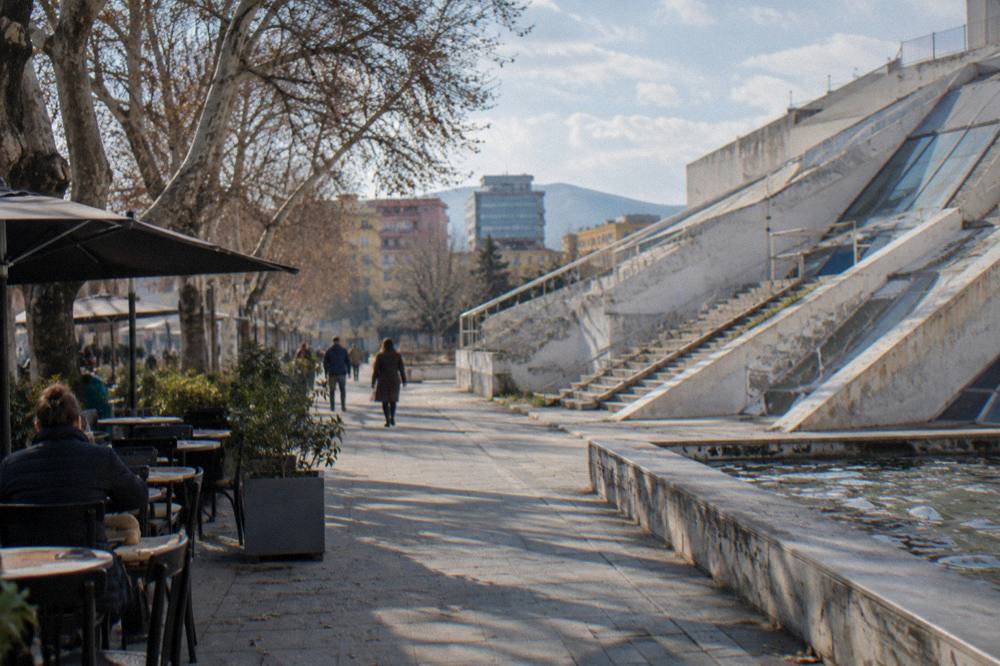
The steps are the renovation's signature move: rather than restoring the old entrance sequence, the redesign turned the building's skin into a public stairway. From the top, the view runs toward Skanderbeg Square to the north-west and down the boulevard toward Mother Teresa Square and the Grand Park of Tirana to the south. The full climb takes only a few minutes, though the incline is real and the surface is stepped concrete rather than a finished staircase.
Two cautions come with the experience. First, the steps are unguarded at the edges in places, so children need supervision; the Tirana With Kids itinerary folds the Pyramid into a family day for exactly this reason. Second, the interior belongs to TUMO and is a working education space rather than a public attraction; do not plan an interior visit without checking locally what access exists on a given day. The exterior, by every account, is the show.
If a climb-up view is what you are after, Tirana offers two others with their own character. The Clock Tower rises about 0.2 km south-east of the square, with about 90 steps inside a narrow stair, though no posted hours or fee exist, so confirm at the site. The Dajti Ekspres cable car lifts you to Mount Dajti, about 9.8 km from the square as the crow flies; the operator sells tickets only at the lower station and publishes no online fare, so check the price there.
| Climbable viewpoint in central Tirana | Position from Skanderbeg Square | Cost | Notes |
|---|---|---|---|
| Pyramid of Tirana steps | About 0.7 km south-east | Free (reported) | Steep open steps, no ticket |
| Clock Tower | About 0.2 km south-east | Confirm on site | About 90 steps, hours vary |
| Dajti Ekspres cable car | About 4.4 km north-east (lower station) | Confirm at the station | Highest viewpoint in this list |
What Can You See At The Pyramid Of Tirana Today?
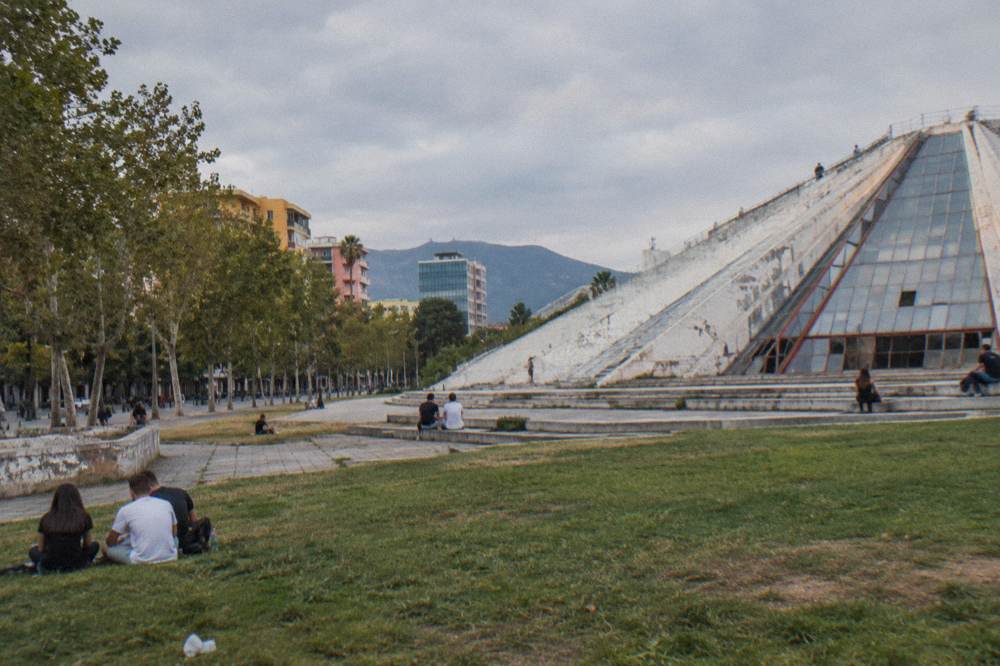
Today the Pyramid of Tirana is a working education and events building: TUMO Tirana, a technology centre for teenagers, occupies the interior, while the exterior steps, the surrounding lawn and the added pavilions function as free public space. There is no museum exhibition inside, so the building's interest is architectural and historical rather than collections-based.
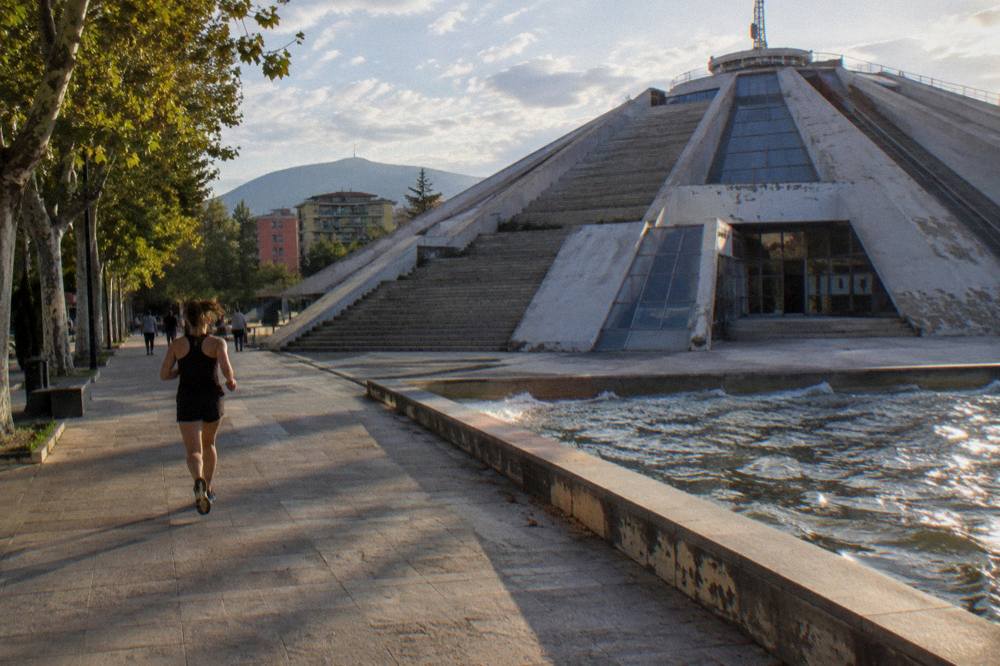
Visitors approaching from the boulevard see a low stepped mound faced in concrete and glass, its slopes alive with people going up and down. Around the base, small colourful boxes house supporting functions for the centre and its surroundings. The lawn and hard landscaping around the Pyramid have become one of the most used open spaces in the centre, sitting between the boulevard, Rinia Park about 0.4 km south, and the cultural axis toward Mother Teresa Square.
What you will not find is a Hoxha exhibition or communist-era displays inside the building itself. That story is told elsewhere in the city, and told well. Bunk'Art 1, about 4.6 km north-east behind the Dajti cable car lower station, occupies the reported leadership nuclear shelter and is open daily 09:30 to 17:30 under the summer 2026 timetable, with tickets bought at the door. Bunk'Art 2, about 0.2 km south-east of the square, covers the secret-police years in an Interior Ministry bunker and is open daily from 09:30. The Pyramid of Tirana entry on the main overview lists both alongside it.
| Communist-era site in Tirana | Distance from Skanderbeg Square | Theme | Access |
|---|---|---|---|
| Pyramid of Tirana | About 0.7 km south-east | From leader museum to tech centre | Exterior free |
| Bunk'Art 1 | About 4.6 km north-east | Leadership nuclear shelter era | Daily 09:30-17:30, tickets at the door |
| Bunk'Art 2 | About 0.2 km south-east | Secret police and surveillance | Open daily from 09:30, tickets at the door |
| House of Leaves | About 0.2 km south-west | Museum of Secret Surveillance | Daily 09:00-19:00 |
| Postbllok memorial | About 0.9 km south | Bunker, prison pillars, Berlin Wall fragment | Public space |
How Do You Get To The Pyramid Of Tirana?
The Pyramid of Tirana sits about 0.7 km south-east of Skanderbeg Square, a walk of roughly ten minutes down the main boulevard from the square, with the building visible on the left as you head toward Mother Teresa Square. City buses run roughly 06:00 to 23:00 with a flat fare of about 40 lek paid in cash on board.
Walking is the obvious choice. From the square, the boulevard runs straight south past the Palace of Culture and the government buildings, and the Pyramid appears after a few hundred metres on the eastern side of the axis. The terrain is flat, pavements along the boulevard are broad, and every central sight listed below is within a fifteen-minute walk of it. A single city bus ride costs about 40 lek, paid in cash to the conductor, and the main boulevard corridors are served throughout the day until roughly 23:00.
From further out, the same logic applies as for the whole centre. The South and North Bus Terminal for intercity services is about 3.9 km north-west of the square, the international bus terminal about 5.9 km south-east, and the airport bus from Tirana International Airport Nene Tereza stops behind the Palace of Opera and Ballet by the square, running 24 hours a day every full hour for 400 lek. There is no airport train: the Tirana-Durres line is being rebuilt, with electrification expected to finish by the end of 2027. Uber and Bolt do not operate in Tirana; local taxi apps do, per local reporting.
| Route to the Pyramid | Figure | Notes |
|---|---|---|
| On foot from Skanderbeg Square | About 0.7 km, roughly 10 minutes | Flat, straight down the boulevard |
| City bus | About 40 lek per ride (reported) | Cash on board, roughly 06:00-23:00 |
| Airport bus to the centre | 400 lek, every full hour, 24/7 | Stops behind the Palace of Opera and Ballet |
| Official airport taxi | About 2,200 lek one way | 20 to 25 minutes to the centre |
| From Bunk'Art 1 | About 4.6 km north-east of the square | Bus or taxi back to the centre |
What Is Near The Pyramid Of Tirana?
Within a fifteen-minute walk of the Pyramid of Tirana you can reach Skanderbeg Square with the Et'hem Bey Mosque and the Clock Tower, the House of Leaves, Bunk'Art 2, the New Bazaar, Tirana Castle and the National Gallery of Arts, making this the densest sight cluster in the city. Mother Teresa Square and the Grand Park lie a little further south.
Work outward in rings. The nearest ring, all inside one kilometre of the Pyramid, holds the square and its landmarks: the Et'hem Bey Mosque, free to visit outside prayer times with modest dress, the Clock Tower beside it, the closed National History Museum, the House of Leaves surveillance museum and Bunk'Art 2. The New Bazaar area, about 0.6 km east of the square, mixes produce stalls with cafes. Tirana Castle, about 0.5 km south-east of the square, wraps a compact dining and shopping street inside old walls.
The second ring takes you south along the boulevard: Mother Teresa Square at about 1.2 km, then the Grand Park of Tirana and the Artificial Lake at about 2.1 km south-east, the city's main green lung. North-east, beyond the ring of close sights, Bunk'Art 1 and the Dajti Ekspres lower station pair naturally on one outing, about 4.4 to 4.6 km from the square. The Blloku cafe quarter and the Postbllok memorial sit about 0.8 to 0.9 km south.
| Sight | Straight-line position from Skanderbeg Square | Walking from the Pyramid |
|---|---|---|
| Et'hem Bey Mosque | About 0.2 km south-east | Under 10 minutes |
| Clock Tower of Tirana | About 0.2 km south-east | Under 10 minutes |
| House of Leaves | About 0.2 km south-west | Under 10 minutes |
| Bunk'Art 2 | About 0.2 km south-east | Under 10 minutes |
| Tirana Castle | About 0.5 km south-east | About 10 minutes |
| New Bazaar | About 0.6 km east | About 12 minutes |
| National Gallery of Arts | About 0.4 km south-east | Under 10 minutes, check status first |
| Grand Park of Tirana | About 2.1 km south-east | About 25 minutes |
| Bunk'Art 1 | About 4.6 km north-east | Bus or taxi |
Which Tours Include The Pyramid Of Tirana?
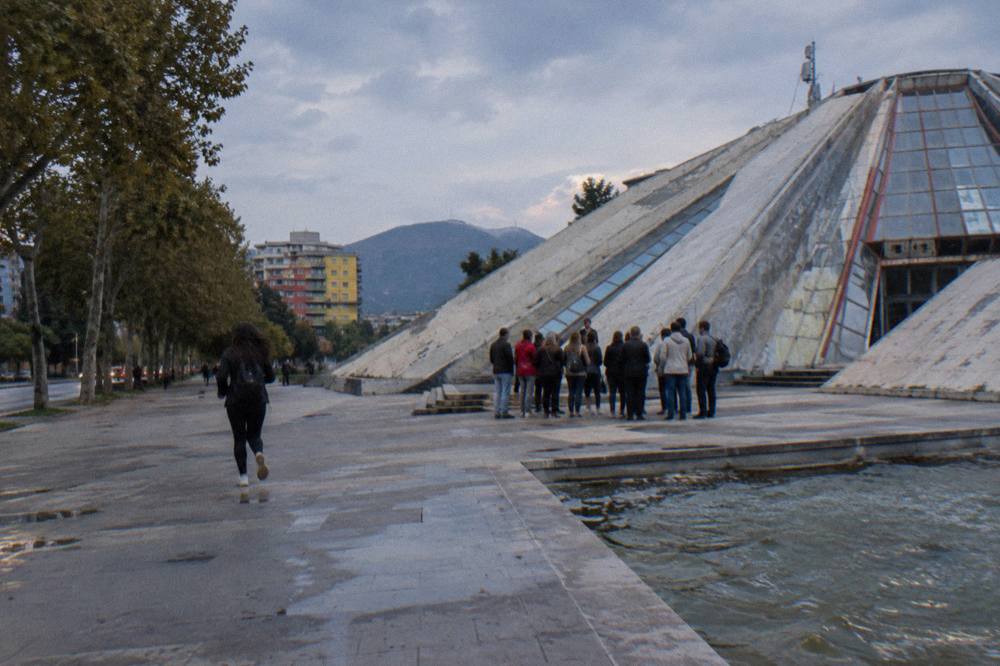
The Pyramid sits on the standard route of central Tirana walking tours and on communist-history itineraries, which typically pair it with Skanderbeg Square, Blloku and one or both Bunk'Art museums. Guided options from the roster below cover the communist-era story with transport included, and the free-standing Komani Lake day trip offers a contrast for a later day.
For a self-planned day, the sequence writes itself: start on Skanderbeg Square, walk the boulevard to the Pyramid, climb the steps, then continue to Postbllok and Blloku to finish where the leadership once lived. Add the House of Leaves or Bunk'Art 2 in the afternoon, or hold the whole communist thread for a guided tour so the context arrives with the buildings. Bunk'Art 1, out at the north-eastern edge, is the one sight where transport matters, and a tour with transport included removes that friction.
When you are ready to look beyond the basin, the mountains and lakes begin closer than their reputations suggest: Petrela Castle is an easy excursion from the centre, and the Komani Lake and Shala River trip pairs two of the country's headline landscapes in a single day from Tirana.
When Is The Best Time To Visit The Pyramid Of Tirana?
The Pyramid's exterior steps are a free public space, so timing is about comfort: ERA5 reanalysis for Tirana, 1991-2020, puts July at a mean high of 29.8 C and August at 30.4 C with only about 31 mm of rain, while November is the highest-rainfall month at about 139 mm. Morning or evening suits summer climbs; winter days average a mild 10.8 C high in January.
The steps are unshaded, which is a pleasure from November to March and a factor from June to September. Early morning and late afternoon also give the best light on the boulevard for photographs. Note that the "best light" claim is not a fact: on 23 October 2026 the sun rises at 07:01 and sets at 17:48, and this shifts by more than an hour across the seasons, so check the forecast and the daylight rather than a fixed rule.
One current-conditions point matters for any central Tirana sight. Demonstrations have been held in central Tirana since 13 October 2026, some violent, and the UK FCDO updated its travel advice on 15 October 2026; avoid gatherings and check local media during your stay. The Tirana Marathon was moved from 24 to 25 October to 14 and 15 November 2026 as a result. Skanderbeg Square and the boulevard around the Pyramid are the parts of the centre where gatherings are most likely.
| Month | Mean high C | Mean low C | Rain mm |
|---|---|---|---|
| January | 10.8 | 2.3 | 106 |
| April | 18.4 | 8.4 | 105 |
| July | 29.8 | 19.1 | 34 |
| August | 30.4 | 19.5 | 31 |
| October | 21.4 | 12.2 | 119 |
| November | 16.5 | 8.0 | 139 |
Common Questions About The Pyramid Of Tirana
Is the Pyramid of Tirana free to visit?
The exterior steps are free to climb, per local reporting, and the surrounding public space is open. The interior belongs to TUMO Tirana, a working education centre, so check locally what access exists on a given day.
Can you climb the Pyramid of Tirana?
Yes. The stepped exterior is reported to be open and free, taking a few minutes up a steep incline to a viewing level over central Tirana.
What was the Pyramid of Tirana originally?
It opened on 14 October 1988 as a museum dedicated to Enver Hoxha, whose rule ran from 1944 to 1991. After communism fell, the building passed through other uses before its renovation.
What is inside the Pyramid of Tirana now?
TUMO Tirana, a technology learning centre for young people, occupies the building since the May 2023 reopening. There is no museum exhibition inside.
How far is the Pyramid from Skanderbeg Square?
About 0.7 km south-east, roughly a ten-minute walk straight down the boulevard from the square.
Is the Pyramid of Tirana a ruin?
No. It was renovated by MVRDV and reopened in May 2023. Descriptions of it as derelict date from the years before the renovation.