Postblloku: The Checkpoint Memorial At The Edge Of Blloku
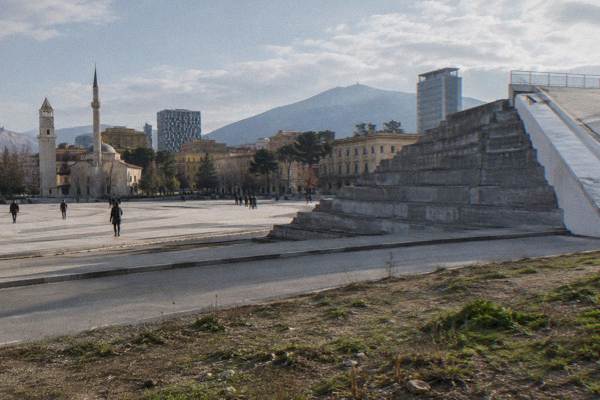
Postblloku is a compact open-air memorial about 0.9 km south of Skanderbeg Square in Tirana, marking the old checkpoint at the entrance to Blloku, the quarter once closed off as the communist leadership's enclave.
Short answer
Postblloku is a free, always-visible roadside memorial at the edge of Blloku in Tirana, built around a communist-era bunker, pillars from the Spac prison and a fragment of the Berlin Wall. It needs no ticket and no more than a short stop, and it pairs naturally with Blloku's cafes and the House of Leaves museum nearby.
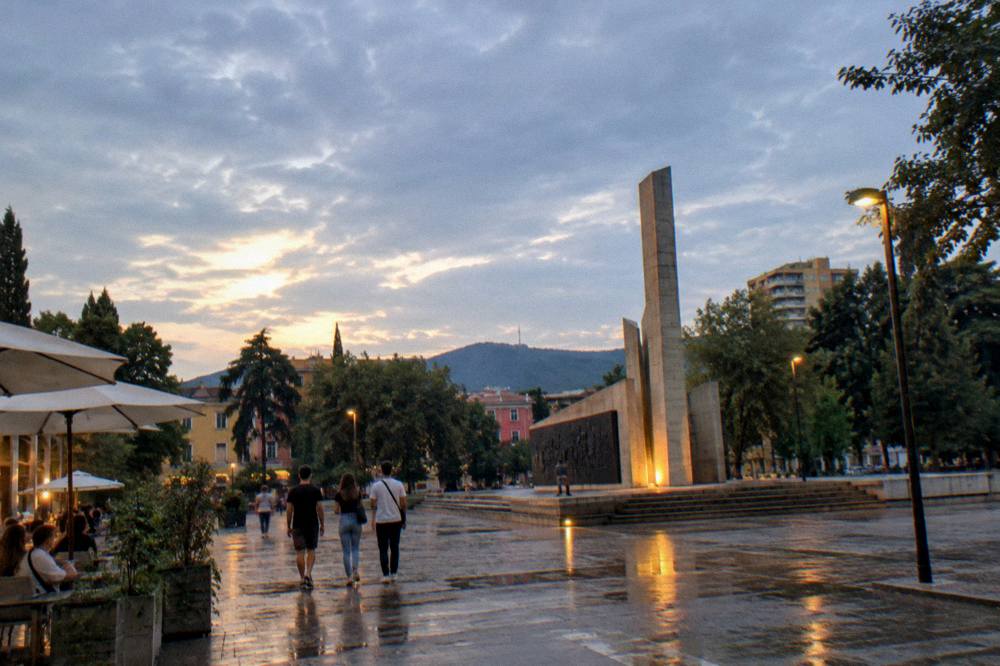
Postblloku stands about 0.9 km south of Skanderbeg Square in Tirana, the capital of Albania, at the point where the city centre gives way to Blloku. It is a small memorial with an outsized story to tell: a concrete bunker, a set of pillars from the Spac prison and a fragment of the Berlin Wall, set together on the grass beside the boulevard. The ensemble marks the edge of what was, under the communist regime that ruled Albania from 1944 to 1991, a sealed quarter where ordinary people of Tirana could not go. Today the same streets are the city's main cafe and bar quarter, and the memorial is free to see at any hour, a two-minute pause on the walk between the square and Blloku.
What Is Postblloku In Tirana?
Postblloku is a free open-air memorial at the edge of Blloku, about 0.9 km south of Skanderbeg Square in Tirana, built from three fragments of the communist period: a small concrete bunker, pillars brought from the Spac prison in northern Albania, and a piece of the Berlin Wall. It has no tickets, no opening hours and no building; it sits on the boulevard and can be seen at any time of day.
The memorial takes its name from the Albanian word for the checkpoint that once stood at this spot, the "post" controlling entry to "Blloku", the block. Under the regime that governed Albania from 1944 to 1991, this area south of the centre was reserved for the party leadership, and entry was controlled. What is reported about the ensemble itself is that its three elements were chosen to stand for three different histories: the bunker for the militarisation of the country, the prison pillars for the labour camps where political prisoners were held, and the Berlin Wall fragment for the isolation of Albania behind closed borders. Each element is original, not a replica, and the grouping is deliberately plain, standing at kerbside rather than inside a museum.
That plainness is the point. Tirana's communist-era story is told in detail at the two bunker museums, Bunk'Art 1 and Bunk'Art 2, but Postblloku tells it in three objects and a place. The location is the fourth exhibit: the very ground behind it was the closed quarter, and standing at the memorial is standing at the line the public could not cross. The Blloku quarter around it, about 0.8 km south of the square, is now the part of Tirana that visitors come to for cafes and nightlife, a reversal the memorial quietly records.
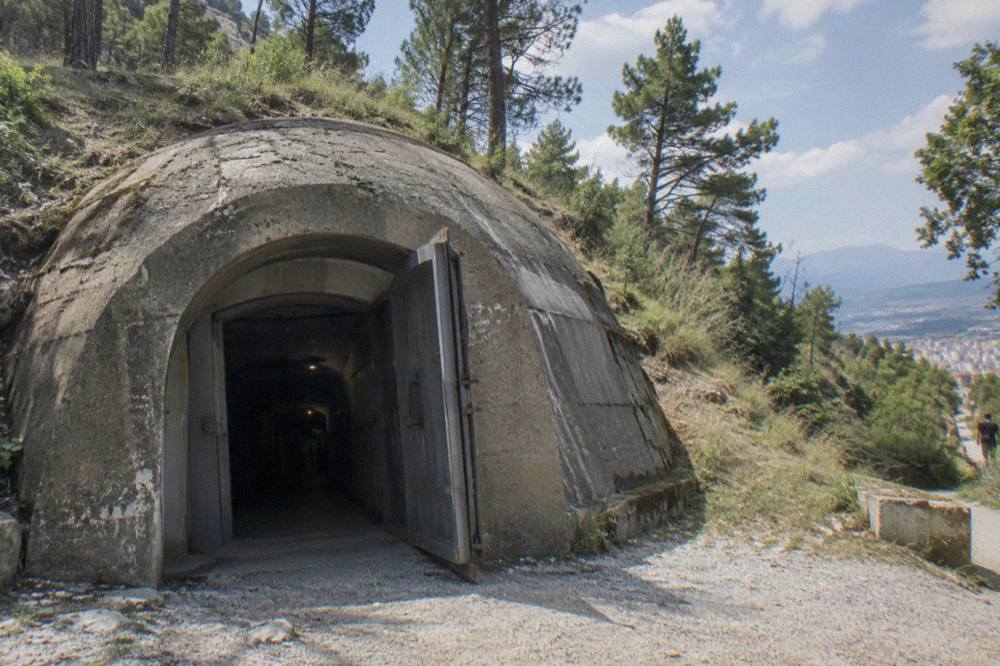
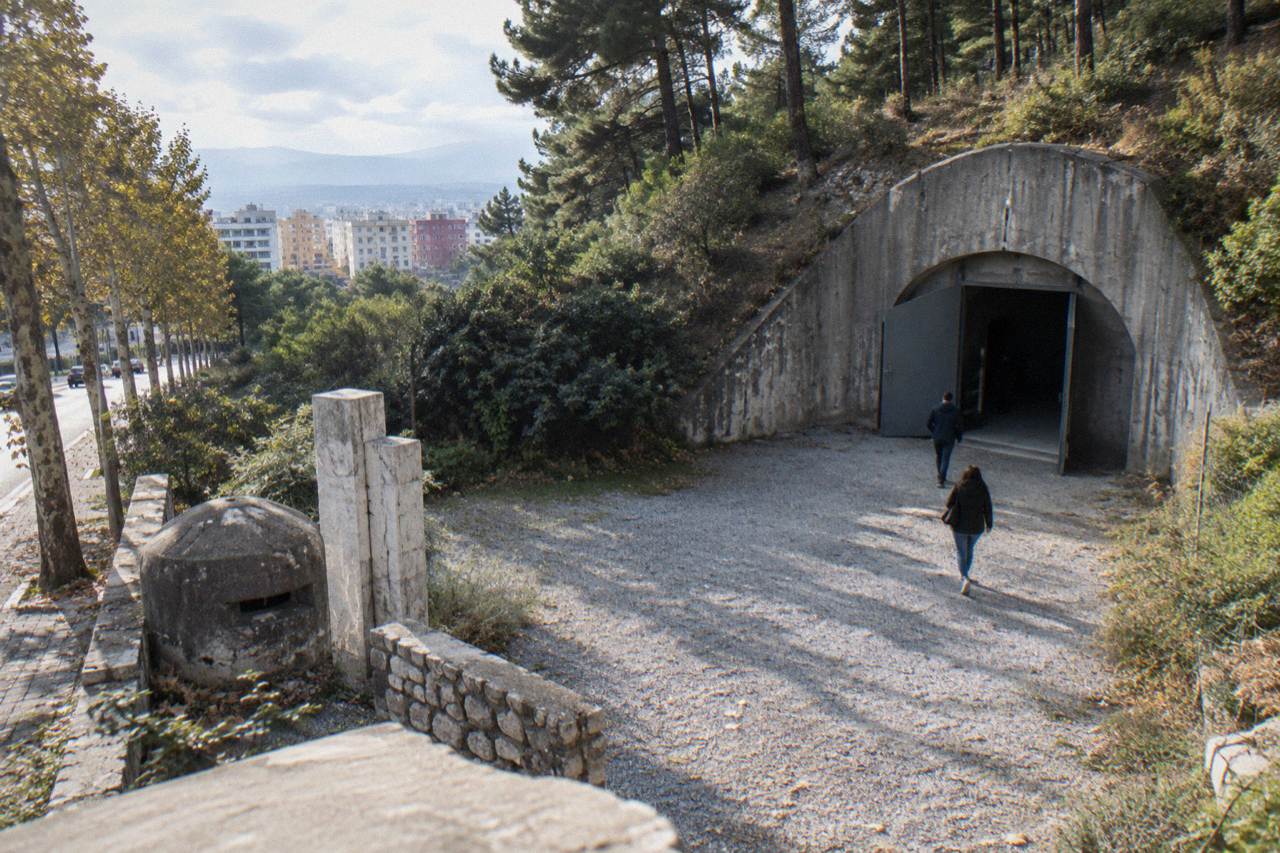
For context on the bunkers themselves, the number quoted in reporting is an estimate of about 173,000 concrete bunkers built across Albania in the communist decades, a figure commonly cited though estimates differ, and never a settled count. One of them, of the same type that dot the countryside from the coast at Durres to the mountains near Theth, sits here as the memorial's first element. The second element, the pillars, is reported to come from the Spac prison, a labour camp in the mountains of northern Albania. The third, the Berlin Wall fragment, places Albania's isolation in its wider European frame.
Where Exactly Is Postblloku And How Do You Reach It?
Postblloku sits on the boulevard at the northern entrance to Blloku, about 0.9 km south of Skanderbeg Square, which is a walk of roughly ten to fifteen minutes along the main southbound axis. There is no station and no car park to find; the memorial is at the kerbside, and the surrounding quarter is a grid of quiet streets that continues south towards Mother Teresa Square, about 1.2 km from the square.
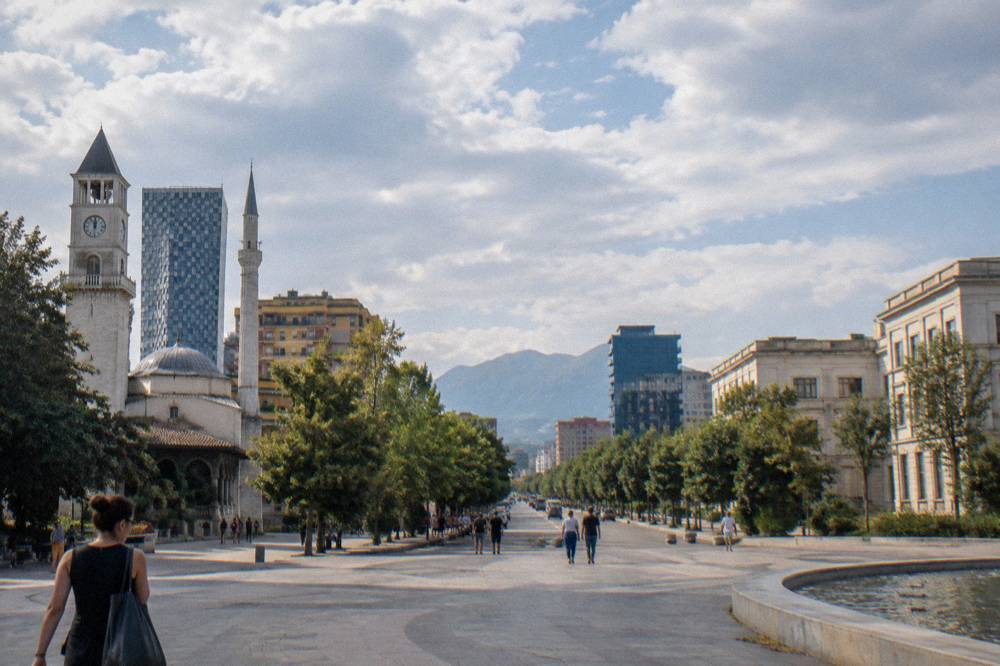
The walk from Skanderbeg Square runs south past the Palace of Culture, then past the crossing with the streets leading to the House of Leaves, which lies about 0.2 km south-west of the square, itself one of the city's key museums of the surveillance years. Continuing south, the memorial appears before the streets of Blloku proper open up. The whole route is flat and central, and it passes several of the city's other sights on the way: the Clock Tower of Tirana and the Et'hem Bey Mosque at the start, the Pyramid of Tirana about 0.7 km south-east of the square, and the Sky Tower about 0.7 km south.
For orientation, the table below places Postblloku against the sights around it, using straight-line positions from Skanderbeg Square.
| Sight | Direction and distance from Skanderbeg Square |
|---|---|
| Postbllok Memorial | About 0.9 km south |
| Blloku | About 0.8 km south |
| House of Leaves | About 0.2 km south-west |
| Pyramid of Tirana | About 0.7 km south-east |
| Sky Tower | About 0.7 km south |
| Bunk'Art 2 | About 0.2 km south-east |
| Mother Teresa Square | About 1.2 km south |
| Grand Park of Tirana | About 2.1 km south-east |
City buses run roughly 06:00 to 23:00, and a single ride costs about 40 lek, paid in cash on board, though for a route this central walking is the natural choice. Uber and Bolt do not operate in Tirana; local taxi apps do, and taxis can be flagged or booked, but for the square-to-Blloku leg there is little reason to take one.
What Do The Three Fragments Of Postblloku Mean?
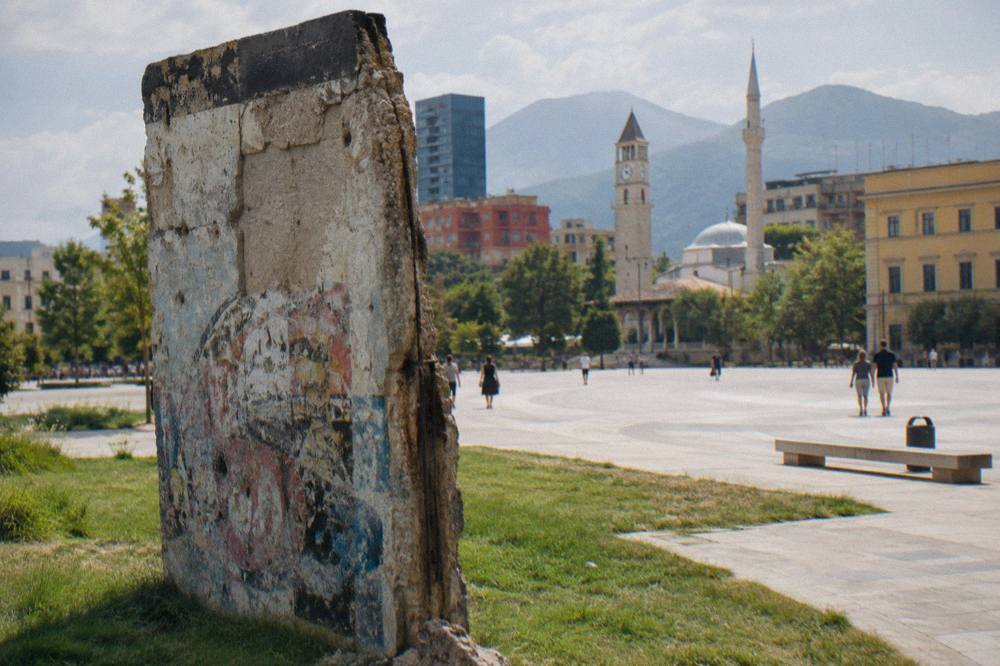
The memorial's three fragments are reported to stand for three strands of the same history: the bunker represents the militarised state that built an estimated 173,000 of them across Albania, the pillars come from the Spac prison and represent the labour-camp system, and the Berlin Wall fragment represents the sealed borders that cut Albania off from the world. Read together, they mark the spot where the closed quarter began.
Each object carries a specific weight. The bunker at Postblloku is one of the small domed concrete types produced in enormous numbers during the communist decades; the figure of about 173,000 is the commonly cited estimate, though it is an estimate and not a census, and reporting on it varies. Whatever the exact count, the type is instantly recognisable anywhere in Albania, from hillsides above the Adriatic coast at Durres to pastures in the northern Alps, and its presence on a central Tirana boulevard compresses that landscape into one object.
The pillars are reported to have been brought from Spac, a prison and labour camp in the mountains between Shkoder and the interior. Reporting on the camp system's scale is thin and contested, and no casualty or prisoner figures may be stated here; what the pillars do, as objects, is carry the physical substance of the camp into the capital, where the decisions that created it were made. The Berlin Wall fragment completes the set by tying Albania's isolation to the wider divided Europe of the same decades.
| Fragment | Reported origin | What it is reported to represent |
|---|---|---|
| Concrete bunker | Albanian bunkerisation programme | The militarisation of the country |
| Stone pillars | Spac prison, northern Albania | The labour-camp and prison system |
| Wall fragment | Berlin, Germany | The sealed borders and isolation of the era |
| The site itself | Former checkpoint at Blloku's edge | The closed quarter for the leadership |
For readers who want the full story rather than the summary in three objects, Tirana has two dedicated bunker museums. Bunk'Art 1, the leadership nuclear shelter behind the Dajti cable car lower station about 4.6 km north-east of the square, is open daily 09:30 to 17:30, per its own website, with tickets bought at the door. Bunk'Art 2, opposite the Municipality about 0.2 km south-east of the square, is the Interior Ministry bunker and is open daily from 09:30, with the closing time varying by season. The House of Leaves, the National Museum of Secret Surveillance, is open daily 09:00 to 19:00 and is the closest of the three to Postblloku.
How Much Time Does Postblloku Take And Does It Cost Anything?
Postblloku is free, needs no ticket and has no gate, so a visit takes as long as you choose to spend, and a short stop of a few minutes is enough to see all three fragments. There is nothing to enter and nothing to queue for; the memorial is a streetscape, and the practical cost of including it in a day in Tirana is simply the walk from the centre, about ten to fifteen minutes from Skanderbeg Square.
That makes it one of the few communist-history sights in the city that involves no planning at all. The museums carry opening hours and door prices to check; Bunk'Art tickets are bought at the entrance, since the museums' own website lists no prices, and the House of Leaves charges admission at rates reported by the museum's listing, which visitors should confirm on arrival. Postblloku asks nothing. It can be seen before the museums open, after they close, or on the way to dinner in Blloku, which is precisely how it fits into a day.
A sensible sequence for a half day of this theme, all on foot, runs like the table below. Distances are straight-line from the square, and each leg is a short walk.
| Order | Stop | Direction and distance from Skanderbeg Square | Cost |
|---|---|---|---|
| 1 | Bunk'Art 2 | About 0.2 km south-east | Ticket at the door |
| 2 | House of Leaves | About 0.2 km south-west | Reported 700 lek adult, confirm on arrival |
| 3 | Postblloku | About 0.9 km south | Free |
| 4 | Blloku cafes | About 0.8 km south | Pay as you go |
| 5 | Mother Teresa Square | About 1.2 km south | Free |
Guided walks bundle the memorial into a wider route through the city's layers, from the Ottoman-era core around the Et'hem Bey Mosque to the communist boulevards. A communism-focused walking tour covers this ground with a guide, and several of the city's guided walks pass the memorial as part of a circuit of the centre; the cards below show what is available.
Why Is Postblloku At The Edge Of Blloku?
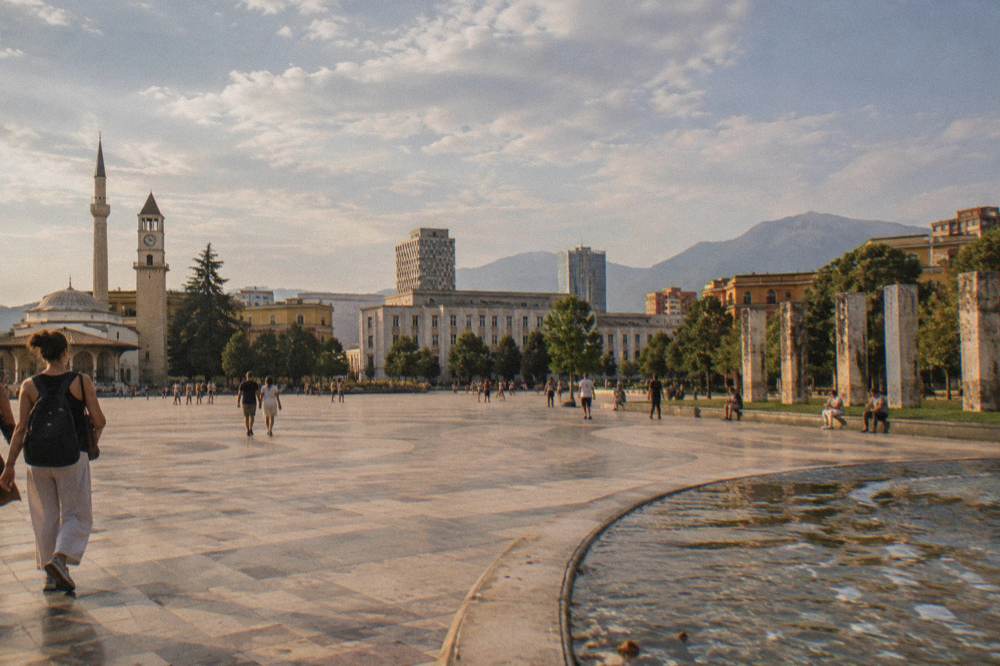
The memorial stands at Blloku's northern edge because that is where the checkpoint stood: under the communist regime that ruled from 1944 to 1991, this quarter south of Tirana's centre was the leadership's residential enclave, closed to the public and entered through controlled posts. After the regime fell, the quarter reopened, its villas gave way to cafes and bars, and the memorial was placed at the old boundary to keep the memory of the closure visible.
Blloku today is reported across current guides as Tirana's main nightlife and cafe district, a compact grid about 0.8 km south of Skanderbeg Square. That present-day identity is the direct inverse of its earlier one, and no plaque is needed to feel the contrast: the streets that once required authorisation now require nothing but curiosity. The guard on this site's history is strict about what can be said, and rightly so, because popular retellings of the period add details that the record does not confirm. What is reported is the basic shape: an enclave, a checkpoint, a reopening, and a memorial assembled from three fragments at the line between the two eras.
The wider neighbourhood walk rewards the short distance. From Postblloku, the streets south lead towards Mother Teresa Square and the Grand Park of Tirana with its artificial lake, both about 1.2 to 2.1 km from the centre, so the memorial sits neatly at the hinge between a history-themed morning and a park or cafe afternoon. Visitors planning a longer stay can fit it into either of the site's ready-made plans, such as the two-day Tirana itinerary, which routes through the centre and south.
What Can You See Near Postblloku On The Same Walk?
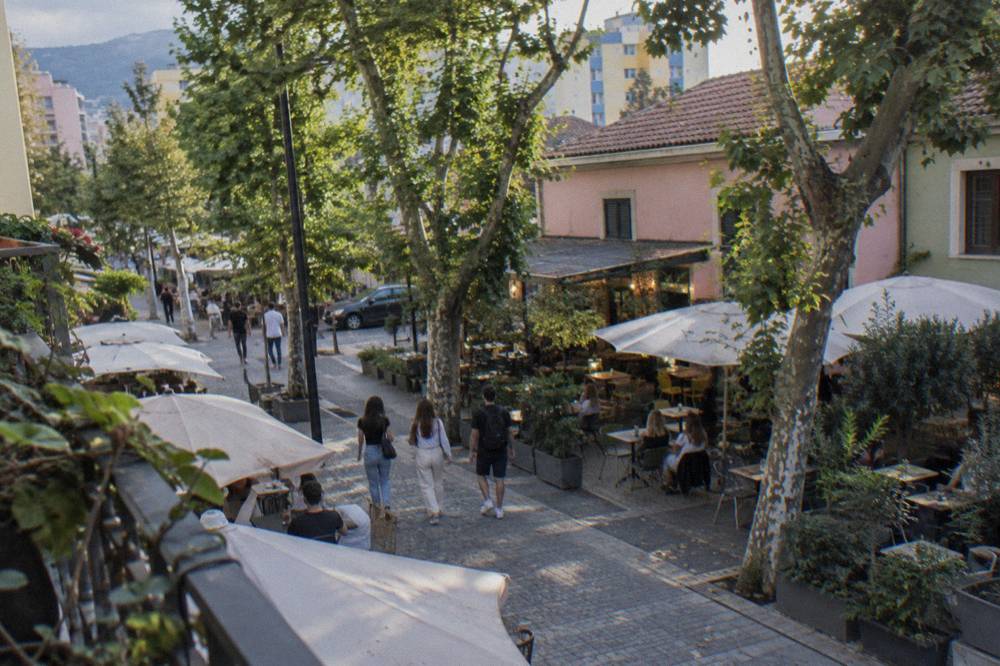
Within a short walk of Postblloku you can reach the House of Leaves museum, Bunk'Art 2, the Pyramid of Tirana, the Sky Tower viewpoint and the whole Blloku cafe quarter, plus, a little further on, Mother Teresa Square and the Grand Park. Every one of these lies between about 0.2 and 2.1 km of Skanderbeg Square, so the memorial is the natural pivot of a walking loop through central Tirana's south side.
The density here is unusually high. The House of Leaves, about 0.2 km south-west of the square, covers the surveillance apparatus of the same regime the memorial commemorates, and is open daily 09:00 to 19:00. Bunk'Art 2, about 0.2 km south-east of the square, extends the bunker story. The Pyramid of Tirana, about 0.7 km south-east, is the renovated 1988 structure now housing the TUMO tech centre; its outside steps can be climbed, and the building should never be described as a ruin. The Sky Tower, about 0.7 km south, offers a rotating view over the basin and the foothills of Mount Dajti. For a full rundown of the city's sights, the site's main guide to Tirana lists the lot, and the Tirana Albania Travel Guide covers each in depth.
| Nearby sight | Approximate position from Skanderbeg Square | Theme |
|---|---|---|
| House of Leaves | About 0.2 km south-west | Secret surveillance museum |
| Bunk'Art 2 | About 0.2 km south-east | Interior Ministry bunker museum |
| Pyramid of Tirana | About 0.7 km south-east | 1988 structure, TUMO centre |
| Sky Tower | About 0.7 km south | City viewpoint |
| Blloku | About 0.8 km south | Cafes and nightlife |
| Mother Teresa Square | About 1.2 km south | Ceremonial axis |
| Grand Park and Artificial Lake | About 2.1 km south-east | Park, walking and lake |
For visitors deciding where to base themselves for this part of town, the site's guide to Where To Stay In Tirana: Centre, Blloku Or Near The Lake maps the central neighbourhoods, and the guide to Tirana nightlife picks up exactly where Postblloku leaves off, inside Blloku's bars and cafes.
When Is The Best Time To See Postblloku?
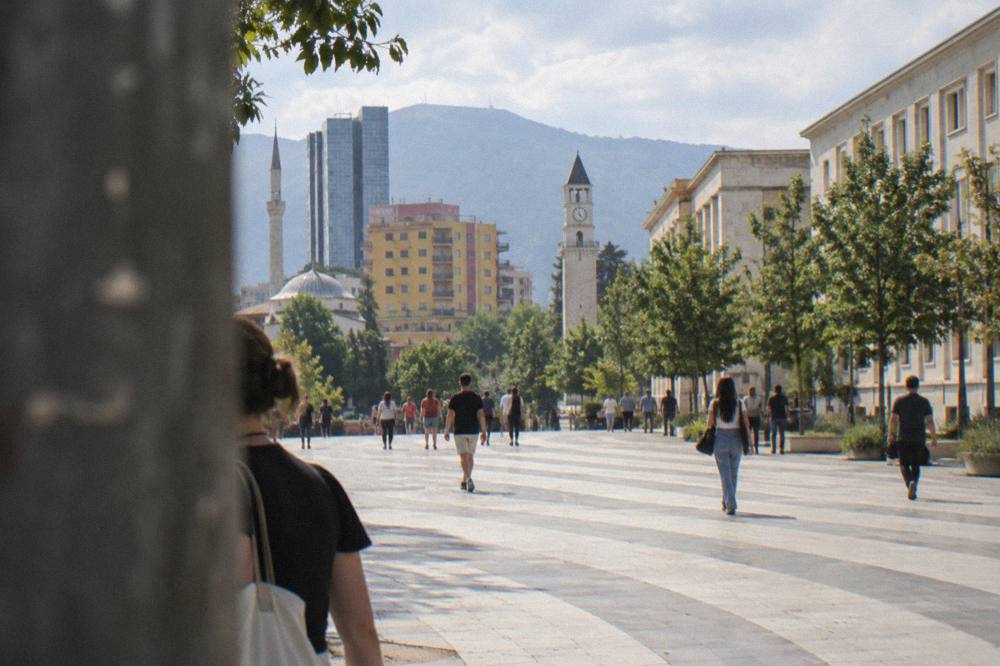
Postblloku can be seen at any hour in any season, since it is an open streetscape with no hours and no gate, so the best time is simply whenever the walk suits your day: mornings pair it with the museums before their queues build, afternoons fold it into a Blloku cafe stop, and evenings let you continue straight into the quarter's bars. There is no ticket to buy in advance and no crowd to beat in any planned way.
Climate plays only a small part in the decision. The ERA5 reanalysis for Tirana, 1991 to 2020, puts the July mean high at 29.8 C and the August mean high at 30.4 C, with August rainfall at just 31 mm, so summer walks are hot but dry, and an early start or a shaded cafe pause in Blloku is the sensible adjustment. November is the highest-rainfall month in the same normals at 139 mm, and January's mean low is 2.3 C with a mean high of 10.8 C, so winter visits are mild rather than harsh and wet rather than frozen. An umbrella covers the November case; the memorial looks much the same in rain.
One current-conditions note belongs on any Tirana page of this season: demonstrations have been held in central Tirana since 13 October 2026, some violent, and UK travel advice was updated on 15 October 2026 accordingly. The guidance is to avoid demonstrations and check local media, and events have been moving in the centre this autumn, with the Tirana Marathon shifted to 14 and 15 November 2026. Check the current situation before your visit.
Is Postblloku Worth Seeing Compared With The Bunker Museums?
Postblloku and the Bunk'Art museums are not rivals but different scales of the same story: Bunk'Art 1 and Bunk'Art 2 are full museums inside real bunkers with exhibits, opening hours and door tickets, while Postblloku is a free three-object memorial you can absorb in minutes. Anyone with a specific interest in the period should do both; anyone with only a morning should walk the memorial, the House of Leaves and the surrounding quarter and treat the bunker museums as the deeper dive.
The bunker museums sit further out and take real time. Bunk'Art 1, the reported leadership nuclear shelter opened in November 2014, lies behind the Dajti cable car lower station about 4.6 km north-east of the square, and is open daily 09:30 to 17:30; Bunk'Art 2, reported to have opened on 19 November 2016 as the Interior Ministry bunker museum, is central and open daily from 09:30. Neither museum publishes ticket prices on its own site, so buy at the door. The Dajti cable car itself, about 4.4 km north-east, is a separate excursion, with tickets sold only at the lower station and no fares published, per the operator's own page.
| Site | Type | Position from Skanderbeg Square | Access |
|---|---|---|---|
| Postblloku | Open-air memorial, three fragments | About 0.9 km south | Free, no hours |
| Bunk'Art 2 | Interior Ministry bunker museum | About 0.2 km south-east | Open daily from 09:30, ticket at the door |
| Bunk'Art 1 | Leadership shelter museum | About 4.6 km north-east | Daily 09:30 to 17:30, ticket at the door |
| House of Leaves | Surveillance museum | About 0.2 km south-west | Daily 09:00 to 19:00, paid entry |
A guided layer adds context that the objects alone do not carry, and the memorial appears on several of the city's themed walks. The picks below include the site's featured evening, an Albanian cultural night with traditional music and dance, which pairs naturally with a late-afternoon walk through Blloku.
How Does Postblloku Fit Into Tirana's Communist History Trail?
Postblloku is one stop on a walkable cluster of communist-era sites that runs from Skanderbeg Square south through Bunk'Art 2, the House of Leaves and the memorial into Blloku, with Bunk'Art 1 and the Dajti Ekspres cable car forming a second cluster to the north-east. Following both clusters, on foot and by bus or taxi, gives a full picture of the regime's machinery and its aftermath in a single day.
The story the trail tells is compact because the geography is. Tirana became the capital in 1920 by decision of the Congress of Lushnja, reported by the national news agency ATA, and the grand axis the memorial sits beside took its present form through successive plans and redesigns, including the 2017 pedestrian redesign of Skanderbeg Square itself. On that square, the National History Museum has been closed for restoration since 15 March 2024, with the announced closure running to March 2028, so its famous mosaic facade is currently a view from outside only, an important planning detail for anyone building a day around the centre. The Skanderbeg Square and National History Museum pages cover that in detail.
For the evening, the related pick below is the site's featured cultural night: an Albanian evening of traditional music and dance that sits a short walk from the memorial, inside the quarter the checkpoint once sealed. Details, prices and availability render on the card.
Common Questions About Postblloku
What is Postblloku in Tirana?
Postblloku is a free open-air memorial about 0.9 km south of Skanderbeg Square, at the northern edge of Blloku. It combines a concrete bunker, pillars reported to come from the Spac prison and a fragment of the Berlin Wall, marking the old checkpoint to the quarter once closed as the communist leadership's enclave.
Does Postblloku cost anything to visit?
No. The memorial is a streetscape with no gate, no tickets and no opening hours, and it can be seen at any time. The nearby museums, Bunk'Art 2 and the House of Leaves, do charge admission, with tickets bought at the door.
How far is Postblloku from Skanderbeg Square?
About 0.9 km south of the square, a walk of roughly ten to fifteen minutes along the main southbound axis, passing the House of Leaves area and continuing towards Blloku.
What do the pillars at Postblloku represent?
They are reported to have been brought from the Spac prison, a labour camp in northern Albania, and to represent the prison and labour-camp system of the communist period, which ran from 1944 to 1991.
Can you combine Postblloku with Blloku nightlife?
Yes, easily. The memorial sits at the entrance to Blloku, reported across current guides as Tirana's main cafe and bar quarter, so an evening walk can pass the memorial and continue straight into the bars.
Is Postblloku the same as Bunk'Art?
No. Bunk'Art 1 and Bunk'Art 2 are full bunker museums with exhibits and door tickets, while Postblloku is a small free memorial of three objects at the kerbside. They cover the same period at different depths.
Postblloku compresses a complicated chapter of Albanian history into three objects at a single kerbside, and it does so at the exact line where that history once turned people away. Walk it on the way into Blloku, read the fragments for what they are, and let the cafes on the far side of the old boundary finish the story.