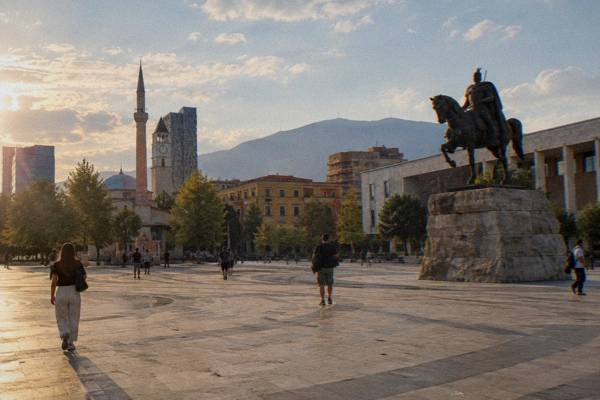
Tirana Castle: The Kalaja Walls And Its Pedestrian Lane
Tirana Castle, known locally as the Kalaja, is a walled enclosure about 0.5 km south-east of Skanderbeg Square in the centre of Tirana, the inland capital of Albania at the foot of Mount Dajti.
Short answer
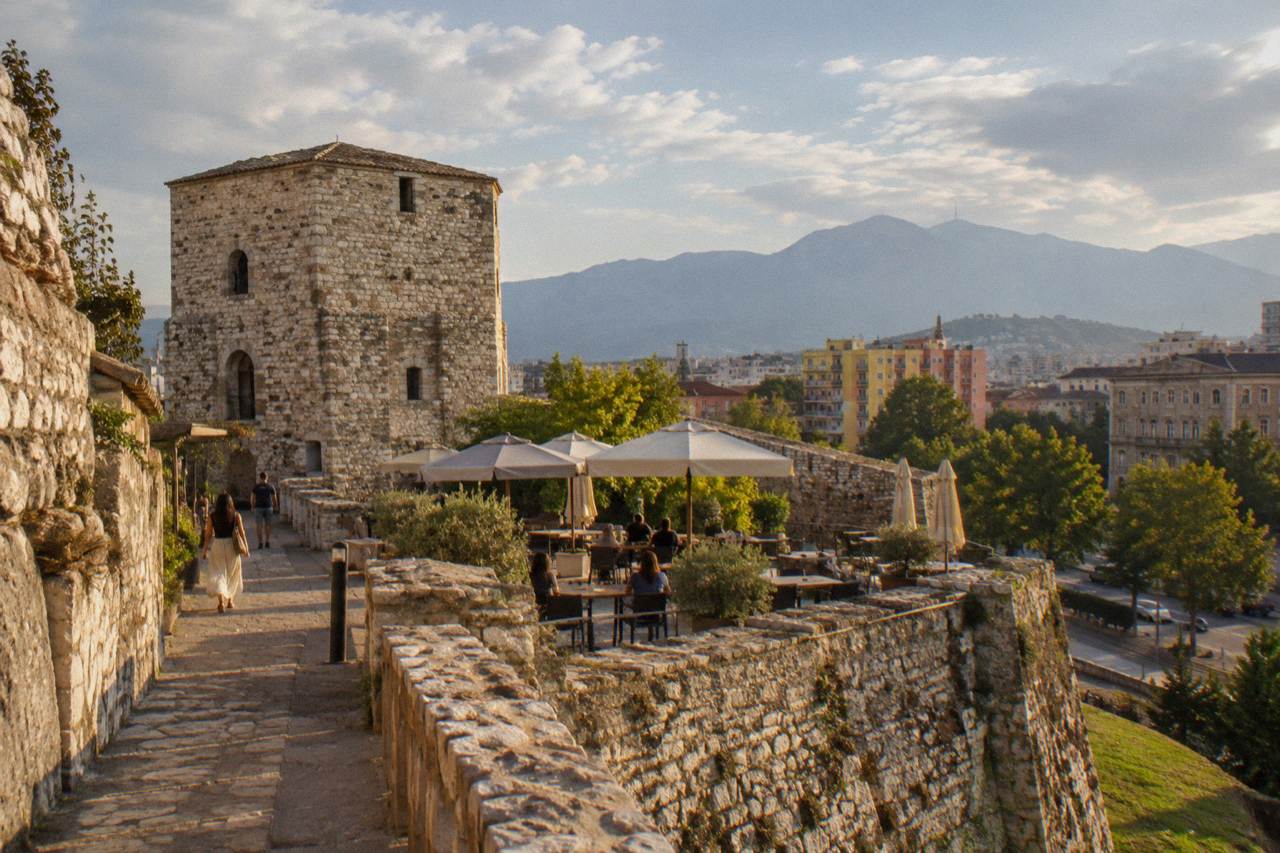
Tirana Castle is a fortified enclosure in central Tirana, about a seven-minute walk south-east of Skanderbeg Square. Its walls enclose a pedestrian lane of cafes, restaurants and bars that runs through the middle, and walking the perimeter and the lane is free at any hour.
Tirana Castle, the Kalaja, is a walled enclosure in the heart of Tirana, the capital of Albania, a city set in a basin at the foot of Mount Dajti and roughly 37 km and 39 minutes by road from the Adriatic coast at Durres. The castle sits about 0.5 km south-east of Skanderbeg Square, close enough that it belongs to any walk through the city centre rather than to a separate excursion. Its walls now frame one of the central pleasures of a Tirana evening: a pedestrian lane of cafes and restaurants that runs through the enclosure, busiest after dark. For travellers assembling a first itinerary, the Kalaja is usually the anchor of the first evening, and it earns that role without a ticket office, a queue or a timetable.
What Is Tirana Castle?
Tirana Castle, or the Kalaja, is a fortified enclosure of Ottoman-era walls in central Tirana, about 0.5 km south-east of Skanderbeg Square, enclosing a pedestrian lane of restaurants, cafes and bars rather than a conventional museum. There is no known construction date or architect, and the site functions today as an open, free-to-walk dining and heritage quarter at the edge of the New Bazaar area.
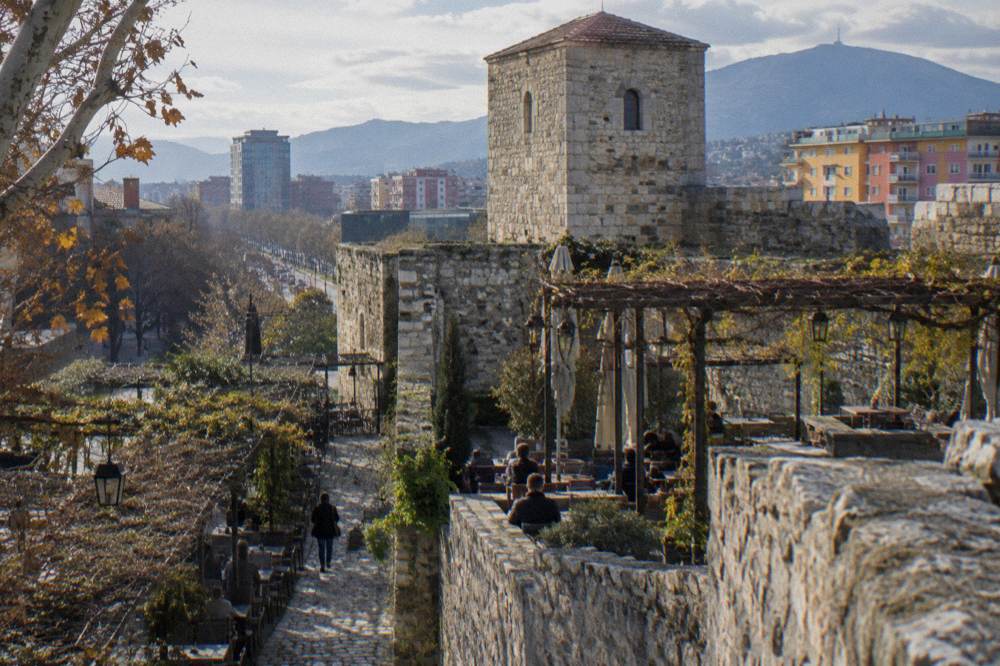
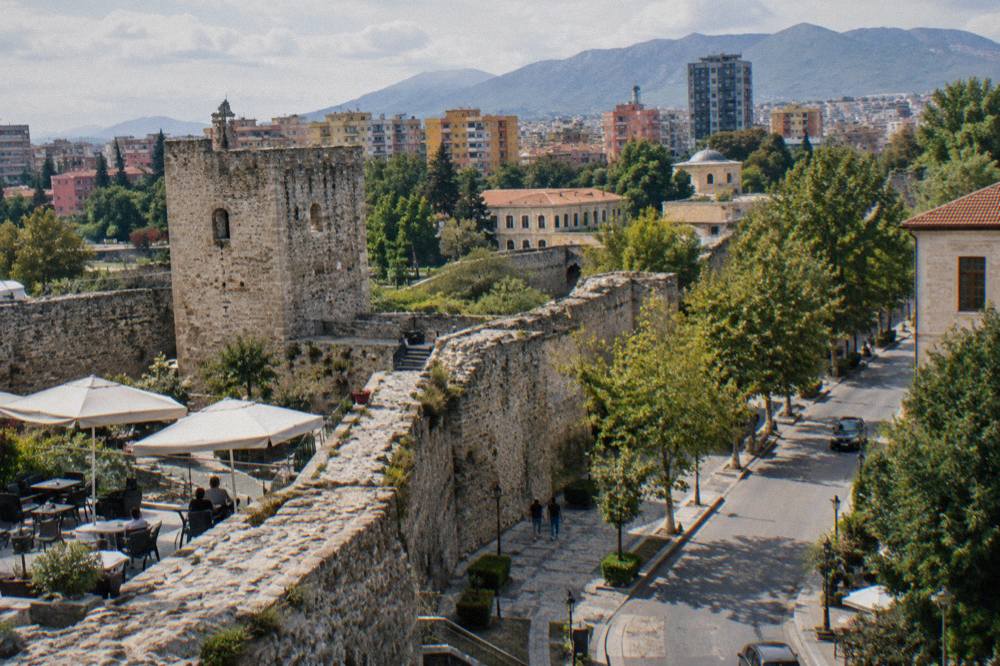
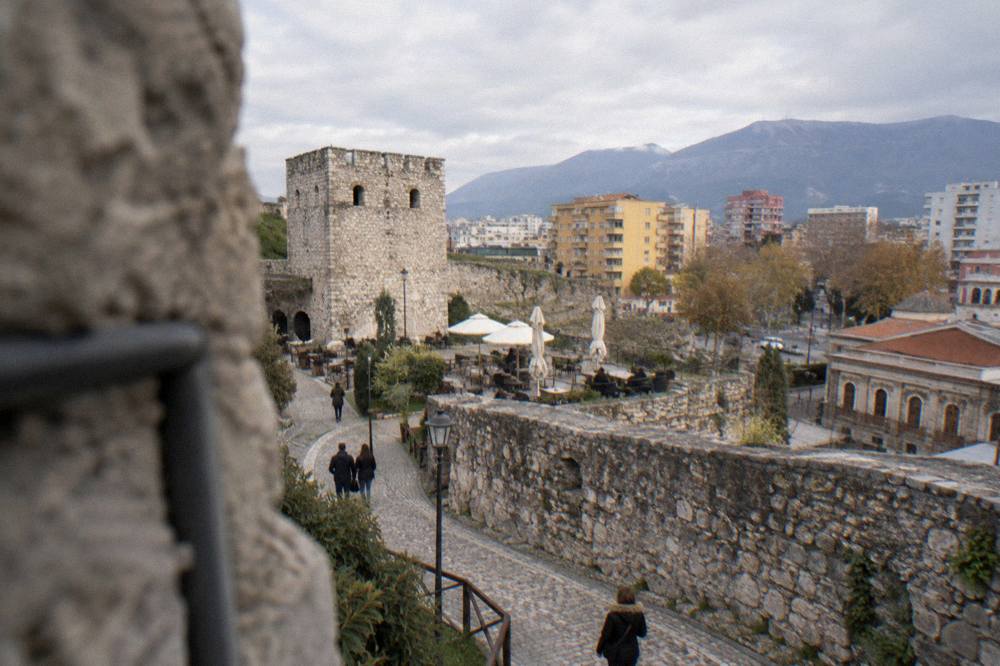
The castle is not a citadel of the Kruja type, with a single gatehouse and a museum inside. It is a low perimeter of stone wall and a handful of rounded towers, with the Murat Toptani street running through it as a pedestrian corridor. On the stretch inside the walls, restaurants and bars have taken over the ground floors of the old structures, and the lane becomes a string of terraces under lamps and vines in the evening. The walls themselves are the sight: rough stone, patched in places, climbing no more than a few metres but still reading unmistakably as a fortification in the middle of a modern capital.
What the enclosure does especially well is connect pieces of the city. The lane emerges at the New Bazaar on one side and toward the government quarter and the boulevard on the other, which makes the Kalaja a natural link between Skanderbeg Square and the New Bazaar in a single walk. Visitors planning a wider loop will find more ideas in the site's things to do in Tirana overview, which places the castle among the central sights.
The enclosure also works as a shorthand for how Tirana treats its past. Instead of fencing the walls off as a monument, the city has let daily life grow inside them, so dinner happens against medieval-looking masonry a few hundred metres from government buildings. That blend is the reason the site photographs so differently at noon and at night, and why a single visit often turns into two: one quick pass in daylight, one longer sitting after sunset.
Where Is Tirana Castle And How Do You Get There?
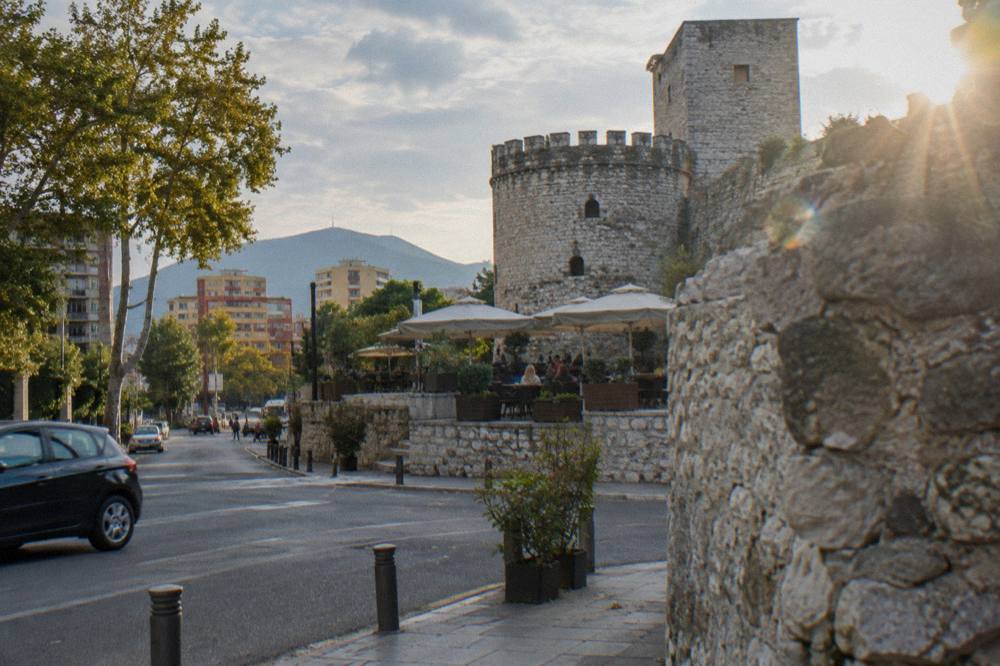
Tirana Castle lies about 0.5 km south-east of Skanderbeg Square in central Tirana, roughly a seven-minute walk from the square along the boulevard side streets, with the New Bazaar about 0.6 km east of the square nearby. No ticket, gate or bus is needed: the site is entered on foot from Murat Toptani street, and city buses run daily from about 06:00 to 23:00.
The walk from the square is short and flat. Head south past the Palace of Culture, cross toward the government buildings, and the walls appear within a few blocks. A single city-bus ride costs about 40 lek, paid in cash on board, but for a site this central the bus is rarely worth it. Taxis operate in the city and ride-hailing apps do exist, but the distance from the square is so short that walking is the sensible default.
Pairing the castle with neighbours is the usual pattern. Tanners' Bridge, an Ottoman-era stone bridge, stands about 0.7 km east of the square, and the Et'hem Bey Mosque sits right on Skanderbeg Square itself, about 0.2 km south-east of the centre point. All of it fits inside an easy one-hour stroll.
| Sight | Straight-line distance from Skanderbeg Square | Direction |
|---|---|---|
| Tirana Castle | 0.5 km | south-east |
| Et'hem Bey Mosque | 0.2 km | south-east |
| Clock Tower of Tirana | 0.2 km | south-east |
| House of Leaves | 0.2 km | south-west |
| New Bazaar | 0.6 km | east |
| Tanners' Bridge | 0.7 km | east |
| Pyramid of Tirana | 0.7 km | south-east |
| Blloku | 0.8 km | south |
| Bunk'Art 2 | 0.2 km | south-east |
Guided walks tie these pieces together efficiently, and the castle is a regular stop on tours that cover the Ottoman and communist layers of the city side by side.
The small-group communist-landmarks walk is the closest thematic fit, since it moves through the same central streets and explains the regime-era history that reshaped the quarter around the walls. The Bunk'Art museums deepen that thread: Bunk'Art 2 is about 0.2 km south-east of the square and open daily from 09:30, while Bunk'Art 1 sits about 4.6 km north-east behind the Dajti cable car lower station and is open daily from 09:30 to 17:30. Tickets for both are bought at the door.
What Can You See Inside The Kalaja Today?
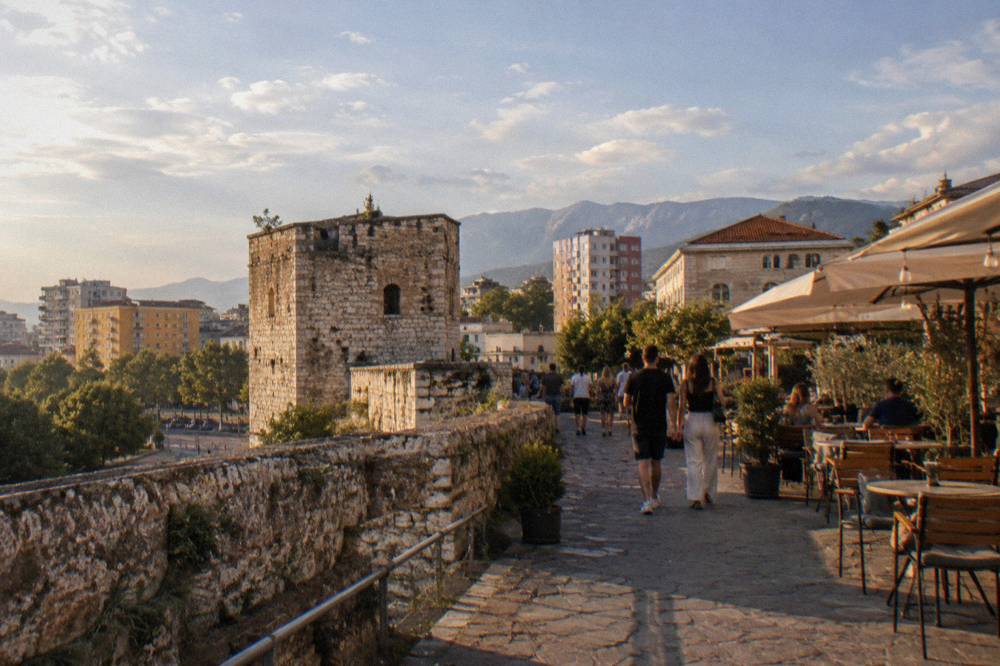
Inside Tirana Castle today you see the surviving stone walls and towers, the pedestrian lane of Murat Toptani street lined with restaurants and bars, and the mix of old masonry and modern terraces that makes the enclosure feel like a dining quarter inside a ruin. There is no ticket office, no museum room and no fixed exhibition: the walls, the lane and the atmosphere are the attraction.
The enclosure works best from late afternoon into the evening, when the lane fills and the walls are lit. In daytime it is quieter and the stonework reads more clearly, especially the tower sections at either end of the lane. Photographers tend to prefer the transition hour, when the lamps come on but there is still light on the stone. There is no published opening or closing time because the lane is a public street; the restaurants set their own hours, so confirm locally if a particular dinner matters to your plan.
For visitors who want the history unpacked rather than just admired, the guided option is worth booking ahead. The tour page on this site, Small-Group Walking Tour of Communist Landmarks, describes what the route includes.
A solo pick for the food-inclined:
Is Tirana Castle Free To Visit?
Yes, walking through Tirana Castle is free: the pedestrian lane is a public street with no gate, ticket or posted hours, and the walls can be viewed and photographed at any time. Food and drink inside are sold at each venue's own prices, which are not published centrally, so check the menu at the table before ordering.
This makes the Kalaja one of the reliable free sights in a city that already gives away a great deal: Skanderbeg Square itself, the Pyramid of Tirana's climbable exterior steps, the Grand Park of Tirana about 2.1 km south-east, and the Tanners' Bridge all cost nothing. The paid sights nearby are few: the House of Leaves, about 0.2 km south-west of the square, is open daily 09:00 to 19:00, and the Bunk'Art museums sell tickets at the door.
One caution for 2026 planning: the National History Museum on Skanderbeg Square has been closed for restoration since 15 March 2024, with the announced closure running to about March 2028. Its mosaic facade can still be seen from the square. Visitors building a museum day around the castle quarter should plan around that closure rather than around it. The rest of the planning pages sit on Tirana Albania Travel Guide.
| Sight near the castle | Entry | Notes |
|---|---|---|
| Tirana Castle lane and walls | Free | Public street, no posted hours |
| Skanderbeg Square | Free | Pedestrian space |
| Et'hem Bey Mosque | Free | Open outside prayer times, modest dress |
| House of Leaves | Ticketed | Daily 09:00-19:00, buy on site |
| Bunk'Art 2 | Ticketed | Open daily from 09:30, buy at the door |
| Bunk'Art 1 | Ticketed | Daily 09:30-17:30 since 1 June 2026, buy at the door |
| National History Museum | Closed | Restoration, announced to about March 2028 |
How Does Tirana Castle Compare With Kruja And Petrela?
Tirana Castle is the smallest and most urban of the three castles usually visited from the capital: it is a dining lane inside old walls, 0.5 km from the centre, while Kruja Castle is a full hilltop museum complex about 45 minutes north by road and Petrela is a small fortress about 22 minutes south-east. Tirana's needs no transport at all; the other two are half-day trips.
The comparison matters because visitors with limited time often pick one castle and assume the rest are similar. They are not. Kruja, about 36.7 km from Skanderbeg Square, pairs its castle walls with the old bazaar and the Skanderbeg Museum; its official AKT page prints no fee or hours, so confirm locally before going, and the site's Kruja day trip guide covers the minibus options. Petrela Castle, about 14.2 km and 22 minutes out, is a compact hilltop site popular for its views and its zipline. The Petrela Castle guide lists what there is to see and do there.
| Castle | Distance from Skanderbeg Square | Travel time by road | Character |
|---|---|---|---|
| Tirana Castle (Kalaja) | 0.5 km | 7-minute walk | Free pedestrian lane, restaurants inside walls |
| Petrela Castle | 14.2 km | about 22 minutes | Hilltop fortress, views, zipline |
| Kruja Castle | 36.7 km | about 45 minutes | Museum complex and old bazaar |
| Elbasan castle walls | 39.5 km | about 42 minutes | Town-centre Ottoman fortifications |
| Shkoder (Rozafa) | 98.4 km | about 118 minutes | Hilltop fortress above the city |
What Is The Pedestrian Lane Like At Night?
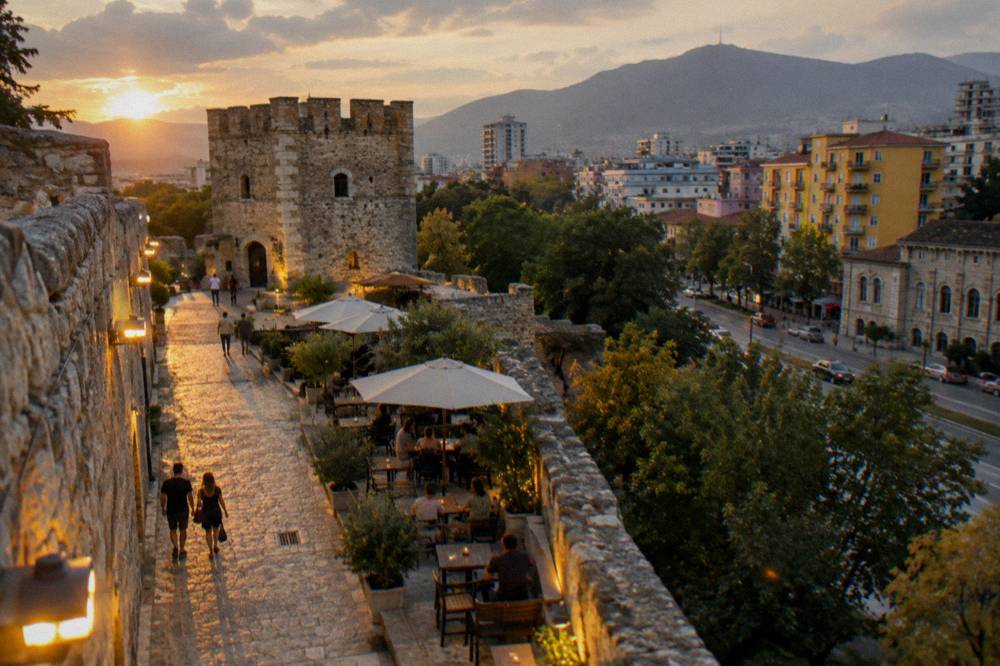
The pedestrian lane inside Tirana Castle is at its liveliest from early evening onward, when restaurant terraces fill, lamps hang over the stone paving, and the walls turn the corridor into one long open-air dining room. No specific bar or club name can be recommended here, but the lane as a whole is the reliable central choice for a dinner inside historic walls.
The lane's character shifts with the hour. By day it is a quiet shortcut with photogenic stonework. After sunset it becomes one of the defining scenes of central Tirana, a narrow canyon of tables under trellises, with the wall towers anchoring both ends. It is a short walk from the Blloku cafe quarter about 0.8 km south, so an evening that starts at the castle can drift naturally toward Blloku afterward, and the site's coverage of Tirana Castle by night and the city's evening options maps that route.
Visitors who want the evening to carry Albanian music and dance rather than just dinner have a dedicated option, and it pairs well with a castle-lane dinner on a separate night:
For a different flavour of the same street-food culture, a qofte and raki tasting stroll also runs through the central lanes.
What Else Is Within Walking Distance Of The Castle?
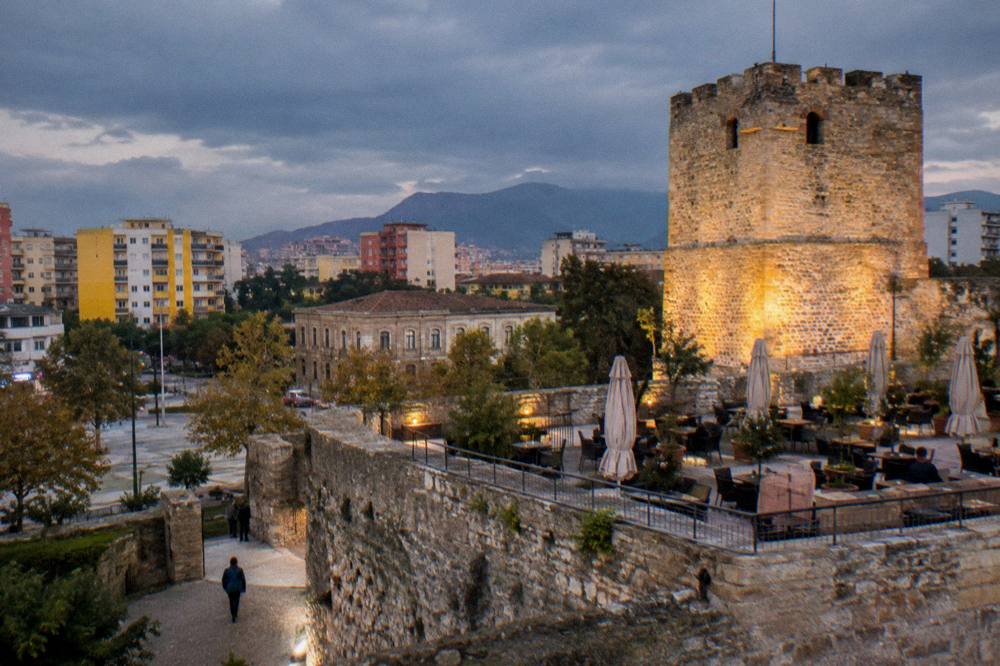
Within a 15-minute walk of Tirana Castle you can reach Skanderbeg Square, the Et'hem Bey Mosque and Clock Tower, the House of Leaves, the New Bazaar, Tanners' Bridge, the Pyramid of Tirana, the Resurrection Cathedral and Bunk'Art 2, all within about 1 km of each other in the city centre. The castle sits at the hinge of this cluster, closer to everything than almost any other sight.
That density is the practical argument for basing a first day around the Kalaja. A sensible loop: start on Skanderbeg Square, step into the Et'hem Bey Mosque outside prayer times (modest dress, shoulders and knees covered, shoes off), walk south to the castle lane for a look at the walls, continue east to Tanners' Bridge and the New Bazaar, then swing back west past the House of Leaves to the Pyramid, whose exterior steps can be climbed free. The whole circuit is flat and needs no transport.
Add an optional extension for a longer afternoon. The National Gallery of Arts about 0.4 km south-east of the square has been under renovation, so check its status before going, and the Resurrection Cathedral about 0.2 km south of the square makes a short stop between the castle lane and the boulevard. None of these additions requires more than a few minutes of walking between them, which is exactly why the castle quarter rewards slow exploration on foot rather than a rushed checklist.
When Is The Best Time To Visit The Castle Lane?
The most comfortable months for Tirana and its castle lane are May, June and September, when ERA5 reanalysis 1991-2020 puts mean highs at 22.7 C, 26.9 C and 25.7 C with monthly rainfall of 89 mm, 51 mm and 99 mm; July and August are hotter at 29.8 C and 30.4 C highs but drier, at 34 mm and 31 mm of rain. Winter is mild and wet, with January averaging a 10.8 C high and 2.3 C low.
Because the lane is outdoors, rain matters more than temperature. November carries the heaviest monthly total in the normals, 139 mm, and December follows with 138 mm, so an evening on a castle terrace is a summer-and-shoulder-season pleasure. In winter the walls are still worth the short walk, and the covered restaurant interiors take over. These are modelled climate normals for the Tirana grid cell, so treat them as planning ranges, not forecasts.
| Month | Mean high C | Mean low C | Rain mm |
|---|---|---|---|
| Apr | 18.4 | 8.3 | 104.5 |
| May | 22.7 | 12.5 | 89.0 |
| Jun | 26.9 | 16.6 | 51.2 |
| Jul | 29.8 | 19.1 | 33.5 |
| Aug | 30.4 | 19.5 | 31.0 |
| Sep | 25.7 | 16.0 | 98.9 |
| Oct | 21.4 | 12.2 | 119.1 |
| Nov | 16.5 | 8.0 | 138.6 |
A note for October and November 2026 travel: demonstrations have been held in central Tirana since 13 October 2026, some violent, and the UK FCDO updated its travel advice on 15 October 2026, advising visitors to avoid demonstrations and check local media. Skanderbeg Square is a focal point for such gatherings, so keep an eye on local news around any castle-lane evening. The Tirana Marathon, moved from its original October dates, now runs 14 to 15 November 2026.
Planning Tips For The Castle And The Quarter Around It
Plan Tirana Castle as an evening anchor rather than a morning attraction: walk the walls and towers in daylight, return for dinner in the lane, and use the site's central position to reach the New Bazaar, Tanners' Bridge and Blloku on foot. Allow 30 minutes for the walls themselves and as long as you like for the tables.
A few practical notes round out the plan. The currency is the Albanian lek, roughly 90 lek to the euro, and the euro is not legal tender, so carry lek for the lane's smaller venues even though cards are widely taken in central Tirana's larger restaurants. Emergency numbers are Police 112, Ambulance 127 and Fire 128. Albania is not in the EU or Schengen and runs its own 90-in-180-day visa regime for visa-free nationals; US passport holders can stay up to a year without a visa, per the Albanian foreign ministry's visa page, though travellers should confirm entry rules before flying.
For a second evening built on the same central geography, the food walk through the market and lanes covers the castle quarter's tastes with a local guide:
Common Questions About Tirana Castle
Is Tirana Castle free?
Yes. The pedestrian lane through the castle is a public street with no gate, ticket or posted hours, and the walls can be viewed at any time. You only pay for what you eat or drink inside.
How far is Tirana Castle from Skanderbeg Square?
About 0.5 km south-east of the square, a flat seven-minute walk through the central streets. No transport is needed.
How old is Tirana Castle?
No construction date or architect is known for the walls, so treat any precise age claim you read elsewhere with caution. The walls are Ottoman-era fortifications, and the city around them was founded in 1614 by Sulejman Pasha Bargjini, according to the municipality's history page.
Can you eat inside Tirana Castle?
Yes, that is the enclosure's main role today: a pedestrian lane of restaurants and bars runs through the middle of the walls, at its liveliest in the evening. Confirm opening days locally, as each venue sets its own hours.
Is Tirana Castle worth visiting with kids?
The walls and lane are short, flat and free, which suits families with children, and the New Bazaar and Grand Park are an easy extension. The site's Tirana With Kids guide covers family-friendly planning in more depth.
Tirana Castle rewards an unhurried evening: walk the full perimeter once in daylight, then come back as the lamps go on and let the lane do the rest.