Flights To Tirana: Airlines, Routes And Seasonal Links
Tirana, the capital of Albania, is served by one airport: Tirana International Airport Nene Tereza at Rinas, about 29 minutes and 16 km by road from Skanderbeg Square. This guide covers how the airport works, how to reach the centre, and what to plan for after landing.
Short answer
Fly into Tirana International Airport Nene Tereza (TIA) at Rinas, 16 km and about 29 minutes by road from Skanderbeg Square. The official airport bus runs 24/7 every full hour for 400 lek; there is no airport train. Albania is outside the EU and Schengen and uses the lek.
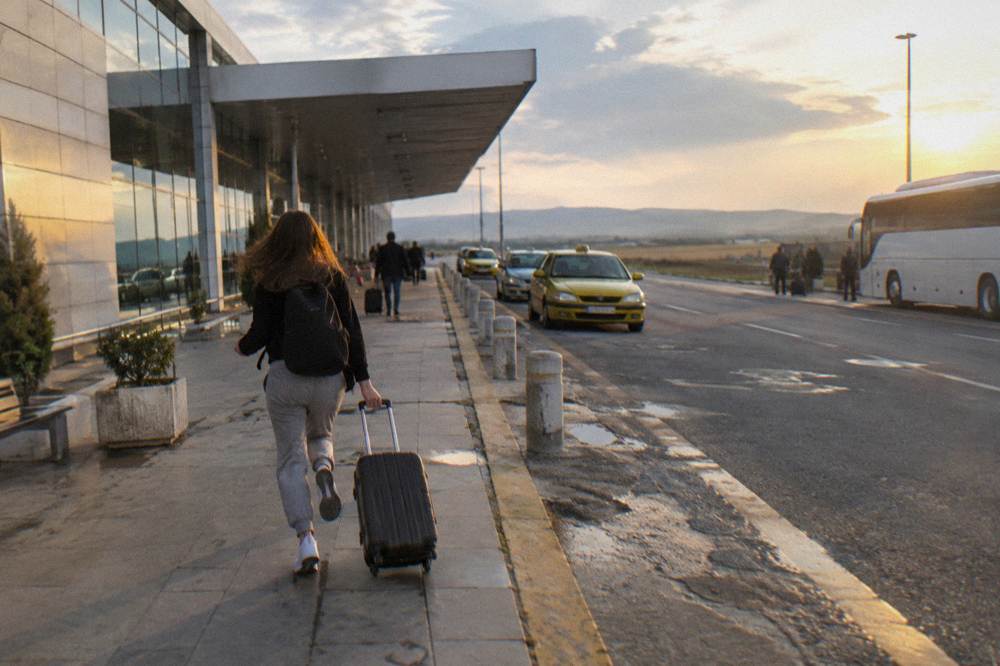
Tirana, the capital of Albania, is an inland city in a basin at the foot of Mount Dajti, and every scheduled flight into the region lands at one place: Tirana International Airport Nene Tereza, known as TIA, at Rinas. The terminal sits 16 km by road from Skanderbeg Square, a drive of about 29 minutes in free traffic. The Adriatic coast at Durres is another 37 km beyond the city, so the airport is the single gateway not only for Tirana itself but for a wide stretch of central Albania. Carriers and routes at TIA change with the seasons, and the airport has grown quickly: reported figures say it handled more than 11 million passengers in 2025, up from about 10.7 million the year before, with expansion of the terminal under way.
Which Airlines Fly To Tirana And What Kind Of Airport Is TIA?
Tirana is served by Tirana International Airport Nene Tereza (TIA) at Rinas, a single-terminal airport 16 km by road from Skanderbeg Square, and the roster of airlines changes by season, so the airport's own carrier list is the one to check before booking. Reported figures say TIA handled more than 11 million passengers in 2025, its busiest year so far, and that low-cost carriers have built large bases there.
That growth matters for anyone shopping for flights. A low-cost base at Rinas means more direct city pairs from across Europe, and it means fares that move sharply with demand. Which routes run in a given month is a commercial schedule, not a fixed fact: it shifts with the summer and winter seasons. Rather than rely on a route list that may be out of date by the time you book, search your departure city against TIA directly and let the results speak.
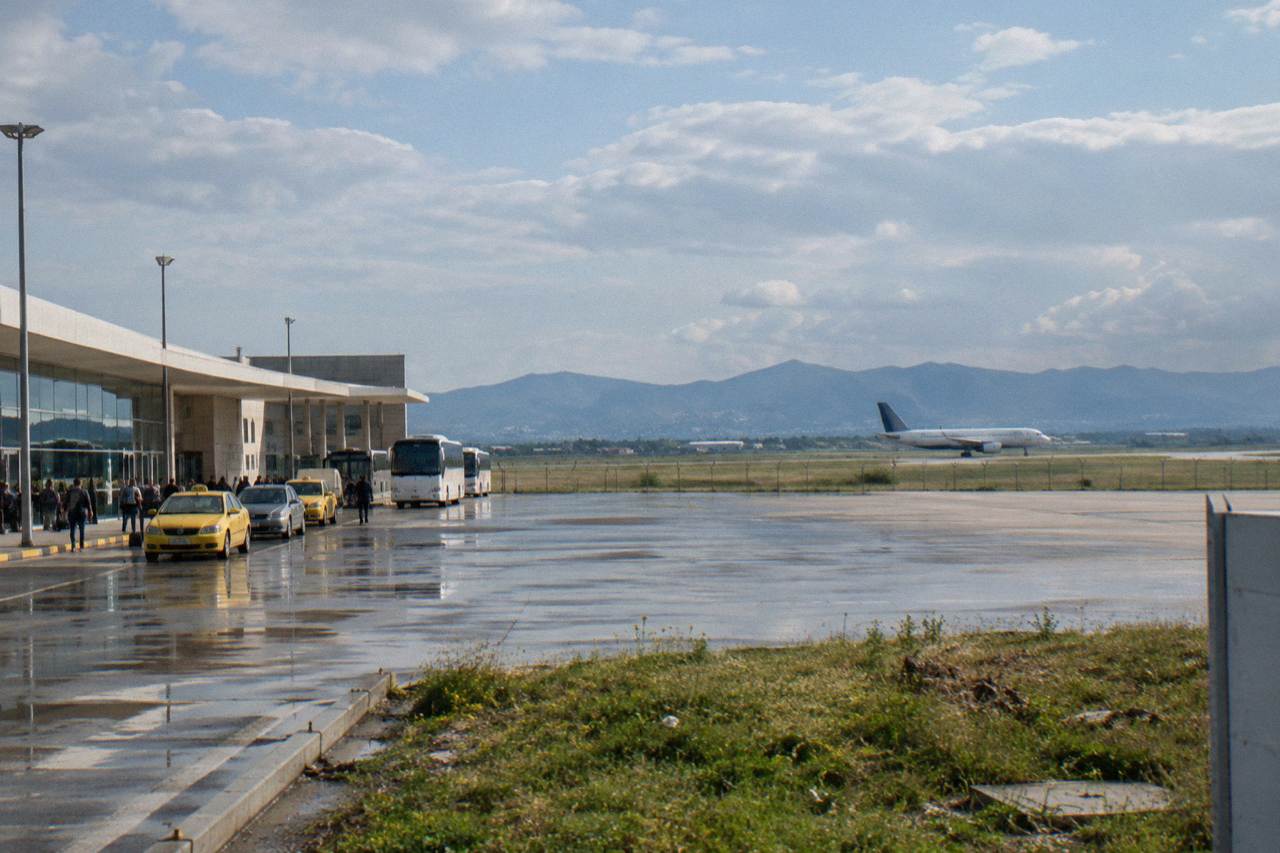
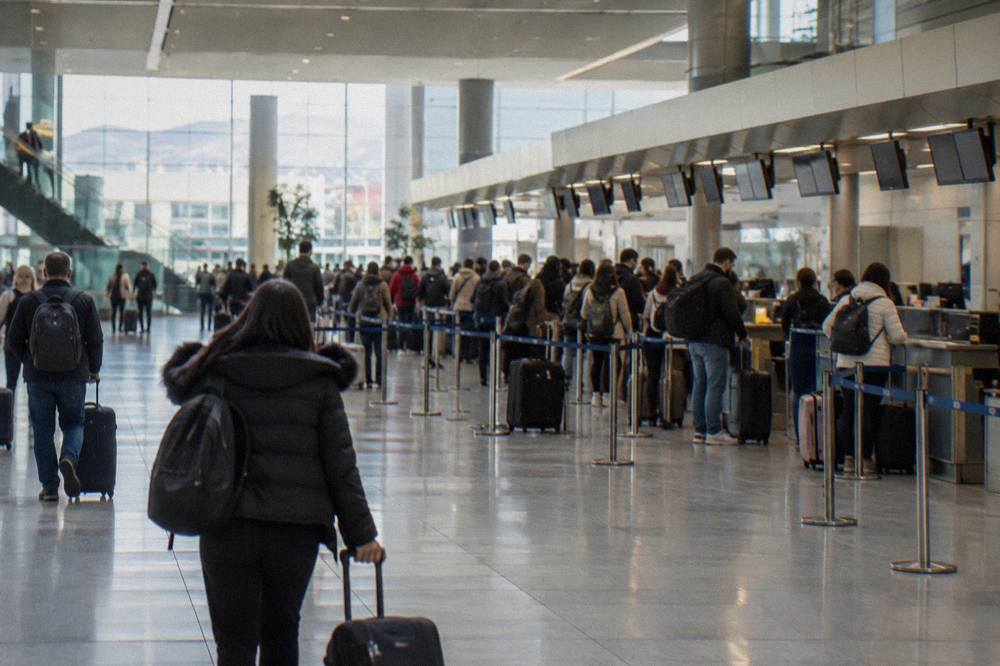
The terminal has expanded to match the traffic. The airport's own pages describe a terminal that has grown in phases, with more check-in desks, gates and stands added as passenger numbers climbed. Car-hire desks from international brands such as Sixt and Avis plus local firms operate in arrivals, ATMs sit in the terminal, and currency exchange is available there too.
One thing TIA is not: a hub for other Albanian airports. Vlora airport, on the south coast, has no scheduled passenger flights, and Kukes airport in the north likewise runs no regular passenger service. Every booked commercial flight into the country, for practical purposes, lands at Rinas.
| Airport | Source | Role for Tirana travellers |
|---|---|---|
| Tirana International Airport Nene Tereza (TIA), Rinas | All scheduled passenger flights | The single arrival airport for the capital |
| Vlora airport | No scheduled passenger flights | Not an arrival option |
| Kukes airport | No regular passenger flights | Not an arrival option |
How Far Is Tirana Airport From The City Centre?
Tirana International Airport is 16 km by road from Skanderbeg Square, a drive of about 29 minutes without traffic, and the official airport taxi covers it in 20 to 25 minutes at a fixed 2,200 lek one way, per the airport's own transport pages. The bus takes 30 to 40 minutes. Those two figures, distance and time, frame every arrival plan.
The road into the city is the main Tirana to Durres corridor, and like any airport road it slows at peak hours. The 29-minute drive can take longer, so allow more when landing on a weekday evening. The official taxi operator, Auto Holiday Albania, branded "TAXI Tirana Airport", runs 24 hours a day and can be pre-booked at tiataxi.al; the airport's transport page lists the centre fare as about 2,200 lek, payable in lek or by card as the operator allows.
For travellers whose accommodation sits away from the centre, the geography is simple: the airport is north-east of the city, the terminal ring roads connect to the northern and eastern districts first, and Blloku or the Grand Park area adds a few more minutes at the end of the drive. Anyone heading straight onward to Durres can skip the city entirely: the airport's own coach to Durres costs 600 lek, with departures from 08:30 to 23:00, a useful link for coast-bound arrivals. The full detail of the transfer options is in the Tirana airport to city centre guide, and wider transport planning is covered in getting around Tirana.
How Do You Get From Tirana Airport To The City Centre?
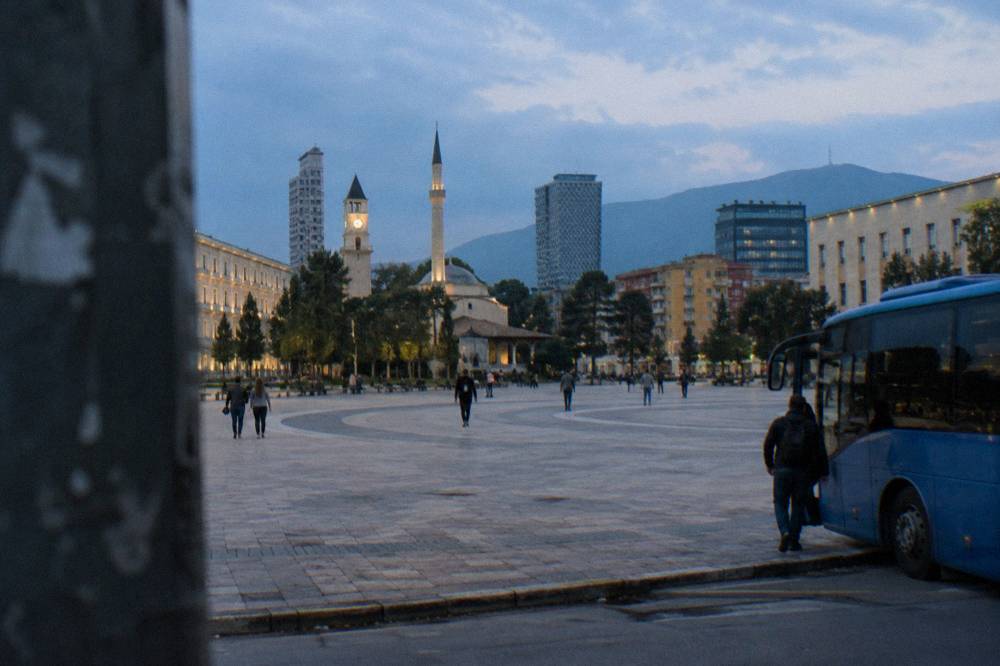
The official airport bus, run by operator LU-NA, runs 24 hours a day, every full hour, for 400 lek or 4.50 euro, taking 30 to 40 minutes and stopping behind the Palace of Opera and Ballet by Skanderbeg Square. The ticket stays valid all day until 23:59, so a delayed landing does not waste it, per the operator's own page.
That bus is the workhorse of arrival at Rinas. Because it departs every full hour around the clock, a 03:00 landing is no obstacle. Buy the ticket on board or at the stop as the operator directs, keep small lek if you have them, and expect the bus to fill on peak evening arrivals. The stop behind the Palace of Opera and Ballet is a short walk from the square itself and from the bulk of central hotels.
A second airport bus line serves the South and North Bus Terminal, the city's intercity hub 4.0 km north-west of the square, for 300 lek or 3.50 euro, hourly, taking 20 to 30 minutes. Terminal-to-airport departures run 07:00 to 18:00 and airport-to-terminal 08:00 to 18:00, per the airport's transport page. That line suits travellers heading straight on to Berat, Shkoder, Durres or the south by intercity bus, skipping the centre altogether; the full departure picture for those lines is in the Tirana bus stations guide.
For onward coastal travel without backtracking, the airport also lists direct shuttles to other cities: Durres at 600 lek, Shkodra at 1,000 lek, Vlore at 1,200 lek and Fier at 1,000 lek, per the airport's own connections page. Long-distance planning to the far south, such as the Saranda run, is covered in the Tirana to Saranda guide.
| Option | Fare | Frequency | Time to centre |
|---|---|---|---|
| Airport bus to city centre (LU-NA) | 400 lek / 4.50 euro | Every full hour, 24/7 | 30 to 40 minutes |
| Airport bus to South and North Bus Terminal | 300 lek / 3.50 euro | Hourly, 08:00 to 18:00 from airport | 20 to 30 minutes |
| Official airport taxi (Auto Holiday Albania) | About 2,200 lek one way | 24/7, pre-bookable | 20 to 25 minutes |
| Airport coach to Durres (Adis) | 600 lek | Departures 08:00 to 23:00 window from 08:30 | Direct, no centre transfer |
Landing in the evening still leaves time for the city. The bus drops you by the square at most 40 minutes after the hour, and Tirana's cafe quarter in Blloku keeps late hours, so a first night does not have to be a hotel room. Once the bags are down, a walk built around the city's communist landmarks gives an arrival evening shape: Communist Past Small-Group Tour for the small-group walk, and read more about the theme in the guide to communist history in Tirana.
Is There A Train From Tirana Airport?
No passenger train runs to Tirana airport, and no passenger train runs between Tirana and Durres either: the line is being rebuilt, with electrification expected to finish by the end of 2027. Until then the bus, the coach and the taxi are the only airport ground transfers.
This is the single most common bad plan for a Tirana arrival. Searches for "train from Rinas" return old timetables and reconstruction news, and neither adds up to a ride. The airport's own transport page lists bus, coach, taxi and car hire, and nothing on rails. Anyone connecting onward from the capital to other Albanian cities uses the intercity bus network: the South and North Bus Terminal publishes departure timetables for Durres from 06:00 at short intervals, Berat from 05:40 about every 30 to 45 minutes, and Shkoder from 05:00 about every 30 minutes, with fares paid to the driver in cash.
When the rebuilt line opens, it will change arrival planning considerably, linking the airport to both Tirana and Durres by rail. Until an official running service is announced, treat any timetable you see as historical.
Do You Need A Visa To Fly To Tirana?
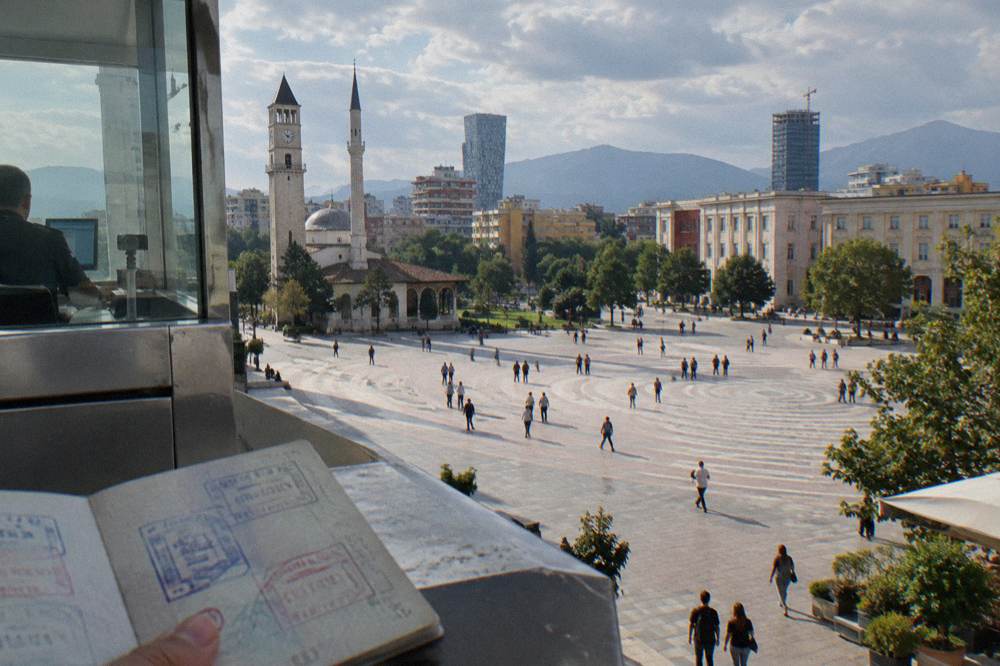
Albania is outside the EU and Schengen and runs its own visa regime: visa-free nationals may stay 90 days in any 180-day period, counted separately from Schengen time. UK citizens enter visa-free for up to 90 days in 180, EU citizens may use a national ID card, and US passport holders can stay up to a year without a visa, per the Albanian foreign ministry's visa page.
The Schengen point matters at the boarding gate as much as at the border. Because Albania is not in Schengen, the EU's EES and ETIAS entry systems do not apply at its borders; your Schengen allowance is untouched by an Albania trip. But a separate allowance it is: 90 days in any 180, watched independently. The UK Foreign Office states UK passports must have an expiry date at least three months beyond the planned departure from Albania.
One generous rule worth knowing: travellers who need a visa for Albania may still enter visa-free if they hold a valid, previously used multiple-entry visa or residence permit from an EU member state, the USA or the UK, per the foreign ministry's regime page. The full breakdown, including passport validity detail, sits in the Albania entry requirements guide.
| Nationality | Entry rule for Albania |
|---|---|
| UK citizens | Visa-free up to 90 days in any 180-day period |
| EU citizens | Visa-free 90 days in 180; national ID card accepted |
| US citizens | Visa-free stay of up to 1 year |
| Visa nationals holding a used multi-entry EU, UK or US visa or permit | May enter visa-free |
What Money Rules Apply Once You Land In Tirana?
Albania's currency is the lek (ALL), and the euro is not legal tender: the Bank of Albania's official rate on 23 October 2026 was 1 euro to 90.74 lek, so think "roughly 90 lek to the euro". Cards are widely taken in central hotels, larger restaurants and supermarkets, but buses, markets and small cafes want cash, and the airport bus fare of 400 lek or 4.50 euro is the first test of that.
The practical sequence on arrival is short. If you land with euros, the airport's exchange desks and ATMs cover the first needs, and changing a modest amount is enough for the bus and a first evening, since card acceptance in central Tirana is broad. ATMs at Albanian banks charge foreign-card withdrawal fees, so a few larger withdrawals beat many small ones. Some hotels, taxis and tourist businesses accept euros informally at their own rate, with change usually given in lek, so do not rely on it as a system.
Once in the city, the lek runs everything from the 40-lek city bus ride to museum doors, and the Albanian lek guide explains notes, rates and where card beats cash in more detail. For a budget overview, the Tirana prices guide gives the structure of what costs money here and what is free, including the fact that several of the city's central sights, from Skanderbeg Square itself to the Pyramid steps, charge nothing at all.
Emergency numbers are worth saving before the first night out: Police 112, Ambulance 127, Fire 128.
When Is The Cheapest And Most Comfortable Season To Fly To Tirana?
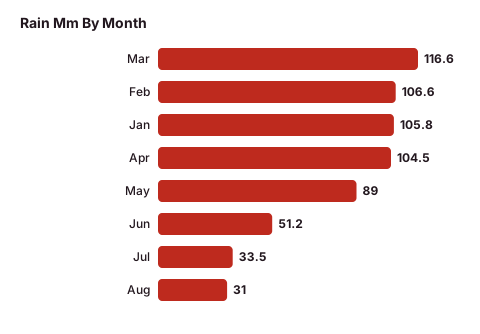
Flights to Tirana are busiest and priciest in July and August, when the ERA5 reanalysis 1991-2020 shows mean highs of 29.8 C and 30.4 C and rainfall of just 34 and 31 mm, and quietest in the November to January window, when rain runs 106 to 139 mm a month and January's mean low sits at 2.3 C. The shoulder months of May, June and September balance both.
The climate table below, from ERA5 reanalysis data for 1991 to 2020, a modelled grid cell near the city rather than a station record, tells the story numerically. Summer is hot and dry: June, July and August together average less rain than November alone. Winter is mild and wet: daytime highs stay near or above 10 C, and November and December carry the year's highest monthly rain totals, at 139 and 138 mm. What the table does not measure is snowfall, so no promise either way on snow.
For flight pricing, supply and demand follow that curve. The summer wave of arrivals into Albania, reported at more than 12 million foreign arrivals for 2025, peaks on the coast, and Rinas carries much of it. Shoulder-season flights are both easier and better matched to a city break: Tirana's museums, cafes and bunker museums do not close for the season, and the city makes a strong base in any month. The month-by-month detail is in the Tirana weather guide and the best time to visit Tirana guide.
| Month | Mean high C | Mean low C | Rain mm |
|---|---|---|---|
| Jan | 10.8 | 2.3 | 105.8 |
| Feb | 12.0 | 2.9 | 106.6 |
| Mar | 15.0 | 5.1 | 116.6 |
| Apr | 18.4 | 8.3 | 104.5 |
| May | 22.7 | 12.5 | 89.0 |
| Jun | 26.9 | 16.6 | 51.2 |
| Jul | 29.8 | 19.1 | 33.5 |
| Aug | 30.4 | 19.5 | 31.0 |
| Sep | 25.7 | 16.0 | 98.9 |
| Oct | 21.4 | 12.2 | 119.1 |
| Nov | 16.5 | 8.0 | 138.6 |
| Dec | 11.8 | 4.0 | 137.5 |
A seasonal note on events, since a festival week moves both flights and hotel rooms: the Tirana International Film Festival ran 21 to 27 September in 2026, the Tirana Jazz Festival followed on 23 to 25 September with free entry, and the Tirana Marathon, moved from October, is set for 14 to 15 November 2026. December brings the Christmas market, which usually runs through December on Skanderbeg Square. Anyone flying into those weeks should expect the arrivals hall and the buses to be busier than the quiet-season norm.
What Can You Do On A Tirana Layover?
A layover of six hours or more at Rinas is enough for a round trip into Skanderbeg Square, about 29 minutes each way by road, with the 24/7 airport bus covering the run for 400 lek and its ticket valid until 23:59, which makes the timing forgiving: one hourly bus in, one hourly bus back, and a few hours in the middle.
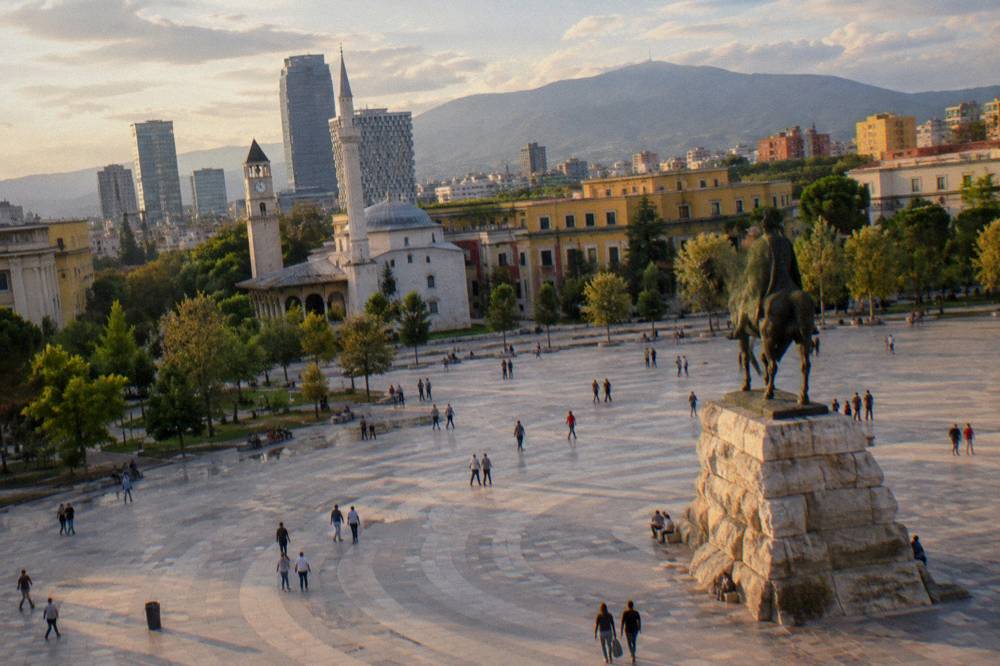
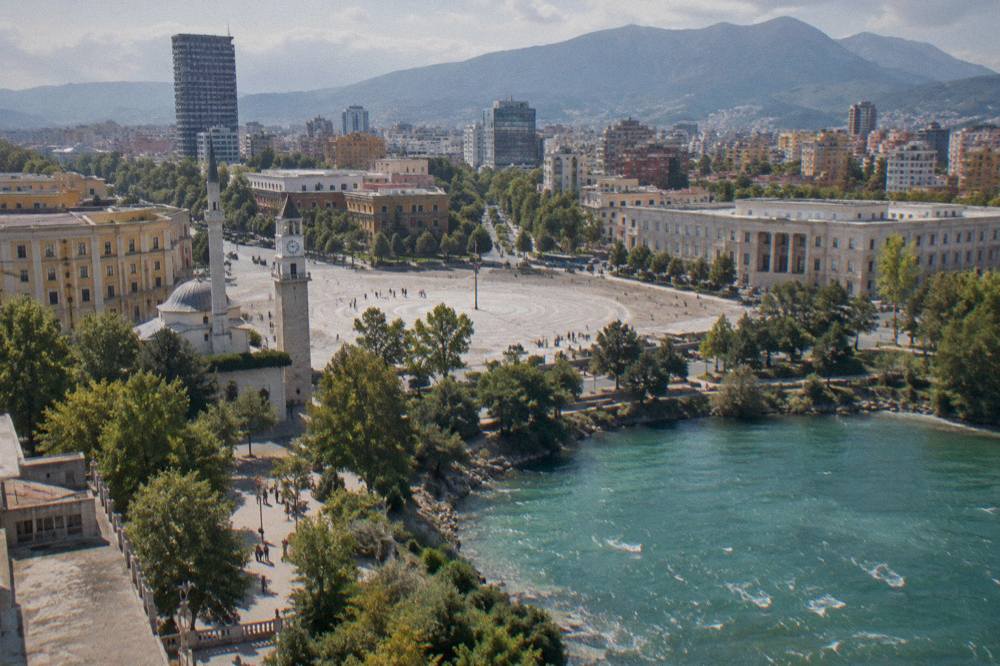
The square is the natural layover target because it concentrates the city. The Et'hem Bey Mosque and the Clock Tower stand at its edge, about 0.2 km south-east of its centre; the National History Museum is closed for restoration until about March 2028, though its mosaic facade can be seen from the square; the Pyramid of Tirana, about 0.7 km south-east, has free outdoor steps that can be climbed; and Bunk'Art 2, about 0.2 km south-east of the square, is open daily from 09:30 with tickets at the door. A layover with less than four spare hours should stay at the airport rather than gamble on the road.
Timing rules are simple. The last thing you want is a missed flight for the sake of a fortress, so work backwards from boarding: leave the square a full three hours before a short-haul departure and four before a long-haul one. The layover itinerary, with sight order and a shorter-stop variant, is laid out in the Tirana layover itinerary, and the fuller sight list lives on the things to do in Tirana page.
Where Should You Stay After Your Flight To Tirana Lands?
Stay central for a short trip: the area within about a kilometre of Skanderbeg Square puts the Et'hem Bey Mosque, Bunk'Art 2, the House of Leaves, the Pyramid, the New Bazaar and Blloku all within a 15-minute walk, and the airport bus stops right there. For longer stays or quieter nights, Blloku, about 0.8 km south, and the Grand Park edge, about 2.1 km south-east, are the alternatives.
The centre wins on arrival logistics alone. The airport bus drops behind the Palace of Opera and Ballet; the South and North Bus Terminal for day trips is 4.0 km north-west; and the walkable core means a first evening needs no transport at all. The Where To Stay In Tirana: Centre, Blloku Or Near The Lake breaks the districts down by budget and character.
Two practical notes shape the choice. First, a current-conditions note: demonstrations have been held in central Tirana since 13 October 2026, some violent, and the UK Foreign Office updated its advice on 15 October 2026, so check the news picture close to travel and avoid gatherings. Second, ordinary caution applies in crowds as in any capital: watch your belongings, and keep the numbers Police 112, Ambulance 127 and Fire 128 to hand. The broader safety picture is in the Is Tirana Safe? Scams, Traffic And Night Walks.
What Should Your First Day In Tirana Look Like?
A strong first day runs Skanderbeg Square, the Et'hem Bey Mosque and the Pyramid in the morning, Bunk'Art 2 or the House of Leaves in the afternoon, and Blloku or the New Bazaar in the evening, all within a walkable kilometre-wide core, with Bunk'Art 1 and the Dajti cable car saved for a second day since both sit about 4.5 km north-east of the centre.
The logic is distance. Everything on the square is free to see and close together; the House of Leaves, about 0.2 km south-west of the square, is open daily 09:00 to 19:00 with adult tickets at 700 lek; Bunk'Art 2, about 0.2 km south-east, opens daily from 09:30, with tickets bought at the door. Bunk'Art 1, behind the Dajti cable car lower station about 4.6 km north-east, pairs naturally with a Dajti Ekspres ride up the mountain, the operator billing it as the longest cableway in the Balkans, with tickets sold only at the lower station and a Tuesday maintenance closure reported, so confirm before going.
A guided start compresses the learning curve, because Tirana's centre is dense with history that a casual walk misses: villa blocks, memorial stones and the former politburo quarter all read differently with a guide. The small-group communist landmarks walk is built exactly for this first day:
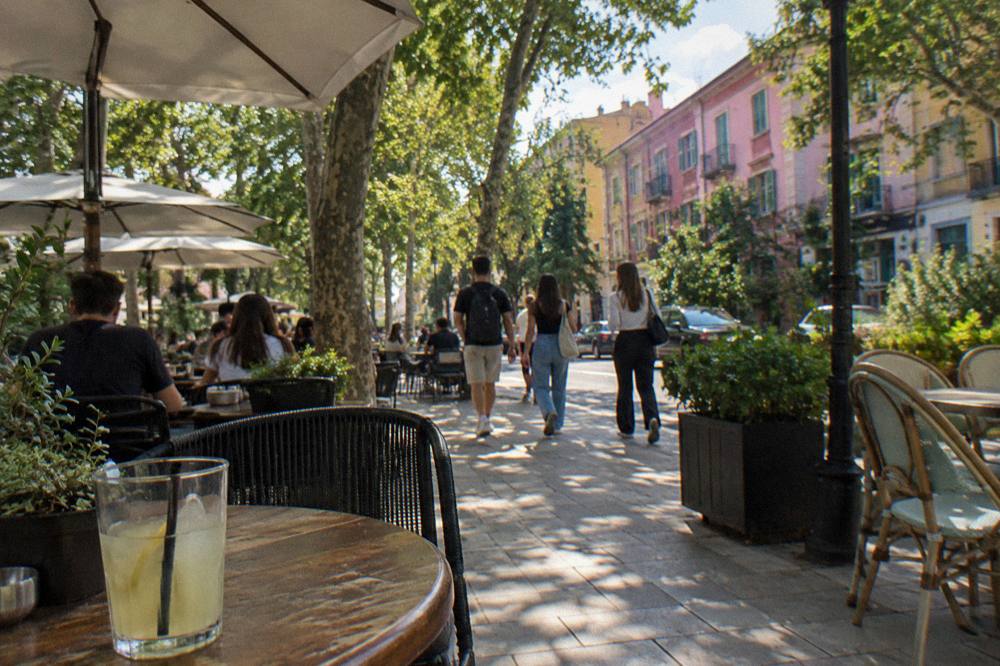
Food fills the evening. The New Bazaar, about 0.6 km east of the square, is the produce-and-grill heart, and Blloku, the former closed politburo quarter about 0.8 km south, is the cafe and bar quarter. Albanian plates worth knowing by name before you land: tave kosi, baked lamb under a yogurt and egg topping; byrek, the layered filo pie; fergese, baked peppers and tomatoes with cheese; and qofte, seasoned grilled meatballs. The Albanian food guide covers the table in depth, and the food-tour option below turns it into dinner:
Which Day Trips Work Once You Have Flown Into Tirana?
From Skanderbeg Square, Kruja is 36.7 km and about 45 minutes, Durres 37 km and about 39 minutes, Petrela Castle 14.2 km and about 22 minutes, and Lake Bovilla 21.4 km and about 61 minutes by road, all realistic half or full days; Berat at 124.6 km and Shkoder at 98.4 km are long days; and Saranda, Ksamil and Butrint, at 250 km and more, are overnight territory.
The airport changes that map slightly. Because a direct airport coach runs to Durres at 600 lek and shuttles run to Shkodra, Vlore and Fier, some day trips can start before the city does. Durres is the classic first or last day: Roman amphitheatre (a few hundred lek, reported), the Archaeological Museum (800 lek, reported), and the nearest sandy beach to the capital.
For the mountains, the Bovilla Lake and Gamti hike tour is the closest big-sky half day, and the Kruja castle and old bazaar tour is the standard history day out. In the evenings, an Albanian night show with traditional music and dinner turns a flight day into something memorable without any further travel:
| Day trip from Skanderbeg Square | Road distance | Approximate drive time |
|---|---|---|
| Petrela Castle | 14.2 km | About 22 minutes |
| Kruja | 36.7 km | About 45 minutes |
| Durres | 37.2 km | About 39 minutes |
| Lake Bovilla | 21.4 km | About 61 minutes |
| Shkoder | 98.4 km | About 118 minutes |
| Berat | 124.6 km | About 122 minutes |
| Ohrid (plus border) | 129.8 km | About 135 minutes |
| Saranda | 252.6 km | About 248 minutes |
Common Questions About Flights To Tirana
How far is Tirana airport from the city centre?
About 16 km by road and roughly 29 minutes in free traffic to Skanderbeg Square; the official taxi takes 20 to 25 minutes and the airport bus 30 to 40 minutes.
Is there a bus from Tirana airport at night?
Yes. The official airport bus to the centre runs 24 hours a day, departing every full hour, for 400 lek or 4.50 euro, and its ticket is valid all day until 23:59.
Do I need a visa for Albania?
Most European and Western nationals do not: visa-free entry runs 90 days in any 180-day period, EU citizens may use a national ID card, and US passport holders can stay up to a year. Albania is outside the EU and Schengen and runs its own regime.
Can I pay in euros in Tirana?
The currency is the Albanian lek, and the euro is not legal tender. Some hotels and tourist businesses accept euros informally at their own rate, with change usually in lek, so plan on lek.
Is there a train from Tirana airport to the city?
No. No passenger train serves the airport. The line is being rebuilt with electrification expected by the end of 2027, but until a service actually runs, the bus, coach and taxi are the options.
What is the best month to fly to Tirana?
May, June and September balance warm weather, mean highs of 22.7 to 26.9 C by the ERA5 1991-2020 reanalysis, with lighter crowds than July and August, and fewer rain days than the November to December peak of 138 to 139 mm a month.
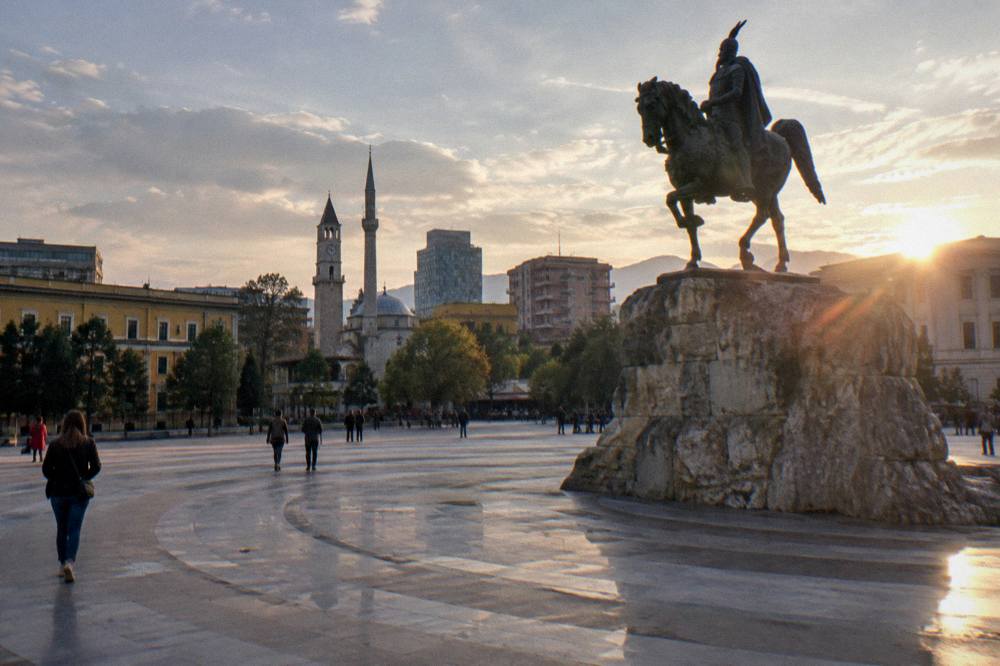
A flight to Tirana is, in the end, the easy part: one airport, one hourly bus, one short road. The city at the other end, with its mosques beside its bunkers and its mountain above the basin, rewards the planning you put into the days after the wheels touch down at Rinas.